
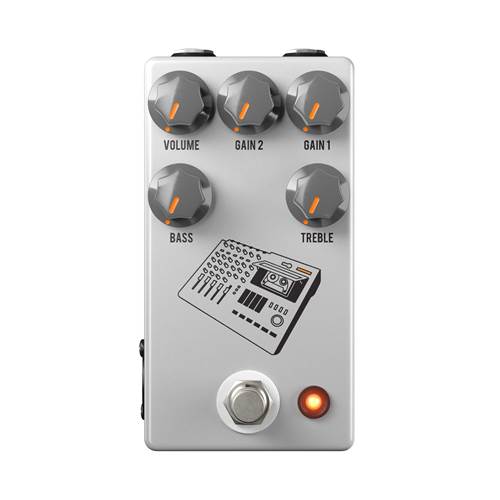
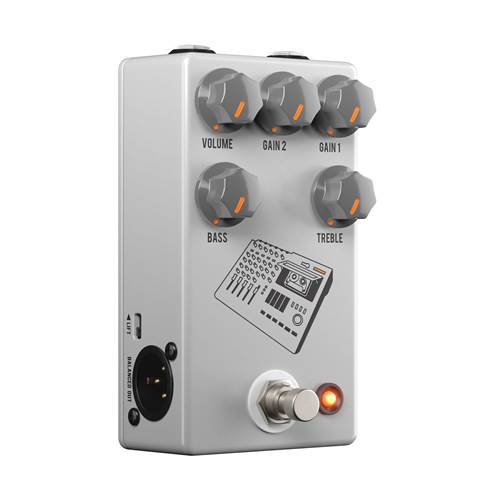
JHS Pedals 424 Gain Stage Preamp
Pairs well with
JHS Pedals 424 Gain Stage Preamp
Description
Quick Product Summary
The JHS Pedals 424 Gain Stage takes one of recording history's most characterful accidental guitar sounds and puts it into a compact pedal. Inspired by plugging a guitar directly into a vintage 424 MKI multitrack recorder and deliberately overloading its input stages, it moves from elastic clean preamp tones through gritty overdrive to compressed, broken-up fuzz.
Rather than approximating the idea with a conventional distortion circuit, JHS recreated the original 424 MKI gain architecture using the UPC4570 and NJM4565 op-amps associated with the original design. Gain 1, Gain 2 and Volume correspond to the recorder's Trim, Channel and Master stages, allowing all three to interact as part of the sound.
The 424 Gain Stage is equally at home on a pedalboard or recording desk. Alongside its standard ¼-inch output, it provides a balanced XLR direct output and ground lift, allowing its lo-fi preamp colour to be recorded directly into a mixer or audio interface.
At A Glance
| Feature | Details |
|---|---|
| Brand | JHS Pedals |
| Model | 424 Gain Stage |
| Condition | New |
| Product Type | Preamp / overdrive / distortion / fuzz |
| Circuit Inspiration | Vintage 424 MKI multitrack recorder |
| Main Appeal | Direct-to-recorder style saturation and lo-fi gain |
| Headline Feature | Two interactive gain stages plus balanced XLR DI |
| Best For | Indie, alternative, garage, lo-fi, recording and experimental guitar |
What's Included?
-
✓ 1 x JHS Pedals 424 Gain Stage Pedal
-
✘ No Additional Accessories Included
Fair Deal Quality Control Assessment
New effects pedals supplied by Fair Deal Music are checked with practical musicianship in mind, including control operation, switching, connections and general signal performance.
The 424 Gain Stage is more than a conventional overdrive, so its complete signal path matters. The two gain stages, Volume control, Bass and Treble EQ, standard output, balanced XLR connection and soft-touch switching all contribute to how the pedal works as both a guitar effect and recording tool.
Why Choose The JHS 424 Gain Stage?
From Elastic Clean Preamp To Broken Fuzz
The interactive gain structure is the heart of the pedal. Keep Gain 1 and Gain 2 restrained for subtle preamp colour and additional level, increase them for compressed overdrive, or push the circuit hard for splattery, overloaded fuzz textures.
A Genuine Multitrack-Recorder-Inspired Circuit
The 424 Gain Stage is not simply an overdrive with a lo-fi EQ curve. JHS recreated the original 424 MKI circuit architecture and corresponding gain controls, giving the pedal the unusual response that made abusing home-recording equipment such an effective creative technique.
Record Direct Through The Balanced XLR Output
A side-mounted balanced XLR output lets you send the 424 Gain Stage directly into a suitable mixer or audio interface. The ¼-inch and XLR outputs can also operate simultaneously, opening up useful live and studio routing possibilities.
Simple EQ That Matters
Dedicated Bass and Treble controls can boost or cut their respective frequency ranges, helping you balance the overloaded preamp character around different guitars, amplifiers and recording setups without removing the personality of the circuit.
JHS 424 Gain Stage vs Popular Preamp & Drive Pedal Alternatives
JHS 424 Gain Stage vs JHS Colour Box V2
The JHS Colour Box V2 is the more comprehensive studio tool, combining its console-inspired preamp architecture with extensive three-band sweepable EQ, high-pass filtering, microphone capability and additional studio-oriented features. The 424 Gain Stage is more focused: choose it specifically for the elastic, overloaded character of a 424-style cassette multitrack input stage in a smaller pedal format.
JHS 424 Gain Stage vs JHS Crayon
The JHS Crayon is a compact route into JHS's console-style preamp distortion concept, ranging from gritty drive to gated fuzz with a Tilt EQ and switchable high-pass filtering. The 424 Gain Stage offers a different circuit lineage, two separately adjustable gain stages and the addition of a balanced XLR direct output.
JHS 424 Gain Stage vs JHS Clover
The JHS Clover is fundamentally a clean preamp and tone-shaping tool, with selectable EQ modes and balanced output making it useful for electric guitar, acoustic instruments and bass. Choose the Clover when clarity, clean boost and controlled EQ are the goal. Choose the 424 Gain Stage when you actively want saturation, compression, grit and deliberately overloaded recording-console character.
JHS 424 Gain Stage vs Hudson Electronics Broadcast
The Hudson Electronics Broadcast also explores studio-preamp-style gain, using a discrete Class-A germanium circuit and transformer-based architecture inspired by vintage broadcast equipment. The 424 Gain Stage takes a different route by recreating the gain stages of a 424 MKI multitrack recorder. Both suit players seeking something outside conventional overdrive designs, but their circuit inspiration and resulting gain character are distinctly different.
Who Is The JHS 424 Gain Stage For?
The 424 Gain Stage is particularly well suited to:
-
Guitarists who enjoy lo-fi and unconventional drive sounds
-
Recording musicians who want direct preamp saturation
-
Indie, garage and alternative players looking beyond conventional overdrive
-
Producers wanting a hardware source of overloaded preamp texture
-
Guitarists who move between clean boost, overdrive and fuzz
-
Players building parallel amp and direct-recording setups
-
Musicians who enjoy pedals with strong studio-equipment heritage
-
Songwriters wanting characterful recording sounds without using a vintage multitrack recorder
Looking for advice on choosing the right preamp, overdrive, fuzz or recording pedal? Our experienced team of musicians can help by phone, online or in our Birmingham showroom.
Suitable Genres & Uses
Indie and alternative guitar: The compressed, imperfect response of an overloaded recording input can give straightforward guitar parts a distinctive character without sounding like another conventional drive pedal.
Garage and lo-fi: Push both gain stages harder for rough-edged distortion and broken fuzz that suits deliberately raw productions.
Clean preamp colour: Lower gain settings can introduce additional level and subtle character before an amplifier or another effect.
Gain stacking: The 424 Gain Stage can be combined with existing overdrive and distortion pedals to add another layer of compression and frequency character.
Direct recording: Send the balanced XLR output into a suitable mixer or audio interface for the kind of direct-input texture that inspired the pedal.
Parallel recording: Because the ¼-inch and XLR outputs can be used simultaneously, the pedal can form part of setups where an amplifier path and direct path are recorded or processed separately.
Why Does Overloading A Multitrack Recorder Sound Different From A Normal Overdrive?
A conventional guitar overdrive is deliberately designed to create clipping in a musically useful way. The distorted sound of an old recording input came from pushing circuitry originally intended to record a clean signal beyond its normal operating range. That misuse created its own compression, frequency response and overloaded texture.
The JHS 424 Gain Stage recreates that idea with separate Gain 1, Gain 2 and Volume stages corresponding to the Trim, Channel and Master controls of the original 424 MKI architecture. Changing the relationship between those stages therefore affects more than the amount of distortion; it changes how and where the signal is being pushed.
Story & Context
Portable multitrack cassette recorders became an important part of home recording during the 1980s and 1990s. They allowed musicians to develop complete arrangements away from a commercial studio and encouraged experimentation with equipment that was never originally intended to function as a guitar effect.
One particularly distinctive technique was to plug an instrument directly into a recorder and deliberately overload its input circuitry. Instead of cleanly capturing the guitar, the recording electronics became part of the sound, producing compression, saturation and eventually aggressive fuzz.
JHS cites records including Bruce Springsteen's Nebraska, Wu-Tang Clan's Enter the Wu-Tang (36 Chambers) and Spoon's Gimme Fiction when discussing the wider significance of home multitrack recording. The guitar textures on Gimme Fiction were particularly influential on JHS's long-running interest in direct-recording preamp sounds.
For the 424 Gain Stage, JHS recreated the original MKI circuit using UPC4570 and NJM4565 op-amps and translated its Trim, Channel and Master gain structure into pedal controls. The result turns a recording technique that once required vintage studio hardware into something that can sit on a modern pedalboard.
Technical Specifications
| Specification | Details |
|---|---|
| Brand | JHS Pedals |
| Model | 424 Gain Stage |
| Effect Type | Preamp / overdrive / distortion / fuzz |
| Circuit Inspiration | 424 MKI multitrack recorder input circuit |
| Op-Amps | UPC4570 and NJM4565 |
| Controls | Volume, Gain 1, Gain 2, Bass, Treble |
| Gain 1 Function | Input preamplification / Trim stage |
| Gain 2 Function | Second gain stage / Channel level |
| EQ | Bass and Treble cut / boost |
| Input | ¼-inch |
| Standard Output | ¼-inch |
| Direct Output | Balanced XLR |
| Ground Lift | Side-mounted switch for XLR output |
| Bypass | Buffered bypass |
| Switching | Silent soft-touch |
| Power Requirement | 9V DC centre negative |
| Current Draw | 50mA |
| Dimensions | 2.6" x 4.8" x 1.6" |
Power Requirements
The JHS 424 Gain Stage requires a regulated 9V DC centre-negative power supply capable of providing at least 50mA.
Do not supply the pedal with more than 9V DC. JHS specifically warns that higher voltage can damage the pedal and void its warranty.
Fair Deal Music Verdict 🎵
★★★★★ 5/5
The JHS Pedals 424 Gain Stage is one of those pedals that makes most sense when viewed as a piece of recording equipment that happens to fit on a pedalboard. It is capable of conventional boost and overdrive duties, but buying it purely for those sounds misses what makes it interesting.
Its real strength is the interaction between the two gain stages. Push them differently and the pedal moves through elastic clean colour, compressed grit, distorted preamp sounds and eventually overloaded fuzz. Add the balanced XLR output and it becomes equally useful beside an amplifier or audio interface.
Best suited for: Guitarists, songwriters and producers looking for distinctive lo-fi preamp saturation rather than another conventional overdrive.
Customers usually upgrade from: Standard boost and drive pedals when they want more unusual gain textures or direct-recording capability.
Most commonly paired with: Overdrive and fuzz pedals, clean amplifiers, audio interfaces, mixers and parallel recording setups.
Our tip: Don't start with both gain controls fully up. Treat Gain 1 and Gain 2 as separate recording stages and experiment with pushing one harder than the other. Their relationship is where much of the pedal's personality lives.
Showroom feedback: The 424 Gain Stage is especially interesting at the boundaries between sounds. Slightly overloaded settings can provide just as much character as the extreme fuzz tones, particularly when recording directly.
Why Buy From Fair Deal Music?
When you buy from Fair Deal Music, you're choosing one of the UK's most established, independent family run music retailers since 1987.
Our Birmingham showroom and knowledgeable musician-led team give you access to friendly, practical advice before and after your purchase. Whether you're choosing a traditional guitar effect, building a recording setup or looking for something more unusual, we're happy to help you find equipment that suits the way you actually make music.
When you shop with Fair Deal Music, you can buy with confidence thanks to:
-
Expert advice from knowledgeable musicians
-
Carefully checked new, used, pre-owned and ex-display equipment
-
Competitive prices on leading music brands
-
Secure online ordering
-
UK-wide delivery
-
Friendly support before and after your purchase
-
Decades of experience with new and pre-owned musical equipment
-
A large Birmingham showroom where you can speak directly with our team
Trade In. Trade Up. Save More.
Thinking about upgrading? Your next piece of gear could cost less than you think.
We're always happy to consider part exchanges and trade-ins on a wide range of musical instruments and equipment. Whether you're looking to upgrade your guitar, keyboard, amplifier, drum kit or studio gear, your existing equipment could help reduce the cost of your next purchase.
Simply get in touch with our team for a no-obligation valuation, and we'll be happy to discuss the options available.
It's an easy way to unlock the value of the gear you no longer use while making your next piece of equipment even more affordable.
Frequently Asked Questions
Is the JHS 424 Gain Stage an overdrive or a fuzz pedal?
It can function as both, as well as a cleaner preamp and boost. The two gain stages determine how heavily the circuit is being driven, allowing the sound to progress from cleaner preamp colour through overdrive and distortion into heavily overloaded fuzz.
What do Gain 1 and Gain 2 do?
Gain 1 corresponds to the Trim control on the original 424 MKI and determines the amount of input preamplification. Gain 2 corresponds to the Channel fader and controls the level feeding the second gain stage. Adjusting them independently changes how the circuit overloads.
Can I record the JHS 424 Gain Stage directly?
Yes. The balanced XLR output is designed for direct connection to a suitable mixer or audio interface, allowing the pedal's preamp saturation to become part of the recorded sound without first passing through a guitar amplifier.
Can I use the XLR and ¼-inch outputs at the same time?
Yes. Both outputs can operate simultaneously, making the 424 Gain Stage particularly useful for parallel signal paths where one feed goes towards a guitar amplifier and another is sent directly to recording equipment.
What is the ground lift switch for?
If a hum or buzz occurs while using the balanced XLR output, the ground lift switch can disconnect the relevant ground connection to help resolve certain grounding problems.
Can the 424 Gain Stage be used as a clean boost?
Yes. Keeping the gain stages at more restrained settings allows the pedal to provide additional level and preamp character without pushing fully into distortion or fuzz.
Where should I place the 424 Gain Stage on my pedalboard?
There is no single required position. Placing it early lets other pedals respond to its preamp colour and gain, while positioning it later allows it to overload a more complex signal. Its unusual gain structure makes experimenting with pedal order particularly worthwhile.
Is the 424 Gain Stage only for lo-fi music?
No. Its heritage naturally suits lo-fi, indie and alternative production, but the clean boost, overdrive, EQ and DI functions can be useful across many styles. It is best considered a character preamp rather than an effect restricted to one genre.
The JHS Pedals 424 Gain Stage is an excellent choice for musicians who want to explore the point where guitar effects and recording equipment overlap. Whether it's providing subtle preamp colour, an unconventional main overdrive, smashed-out fuzz or a direct recording path, it offers a genuinely different approach to gain.
If you have any questions, you are always welcome to contact us. We'll get back to you as soon as possible, within 24 hours on weekdays.
-
Shipping Information
Use this text to answer questions in as much detail as possible for your customers.
-
Customer Support
Use this text to answer questions in as much detail as possible for your customers.
-
FAQ’s
Use this text to answer questions in as much detail as possible for your customers.
-
Contact Us
Use this text to answer questions in as much detail as possible for your customers.
Good to Know
How long is the warranty period?
For new products, you will get the full manufacturer warranty. For our second-hand products, we will cover any fault within 4 weeks of the purchase of any guitar. For pianos, that will be extended to 3 months.
What is the estimated delivery time?
We use the 24hr delivery in UK mainlands if it can be delivered by post. For Scotland and Wales, it depends on the area and the distance from our warehouse, but our aim is to get you order to your hands as soon as possible.
For products that cannot be posted, we will arrange the delivery with you to suit your schedule and deliver it to you
Do you offer international shipping?
We usually can ship instruments worldwide. Please get in touch to get a quote
What is the maintinance on your USED products?
- Guitars: Every guitar will be setup to a high playing standard before shipping. The electronics are checked and if there is any issue with guitar, it will be fixed.
- Pianos: Every piano is fully tested to make sure it's fully functional, cleaned, and if it's digital, a facroty reset is performed.
Do you offer assembly and installation?
We offer installation and assembly for pianos, drum kits, or any products that require it for and extra charge. Please get in touch so we can provide you with a quote.