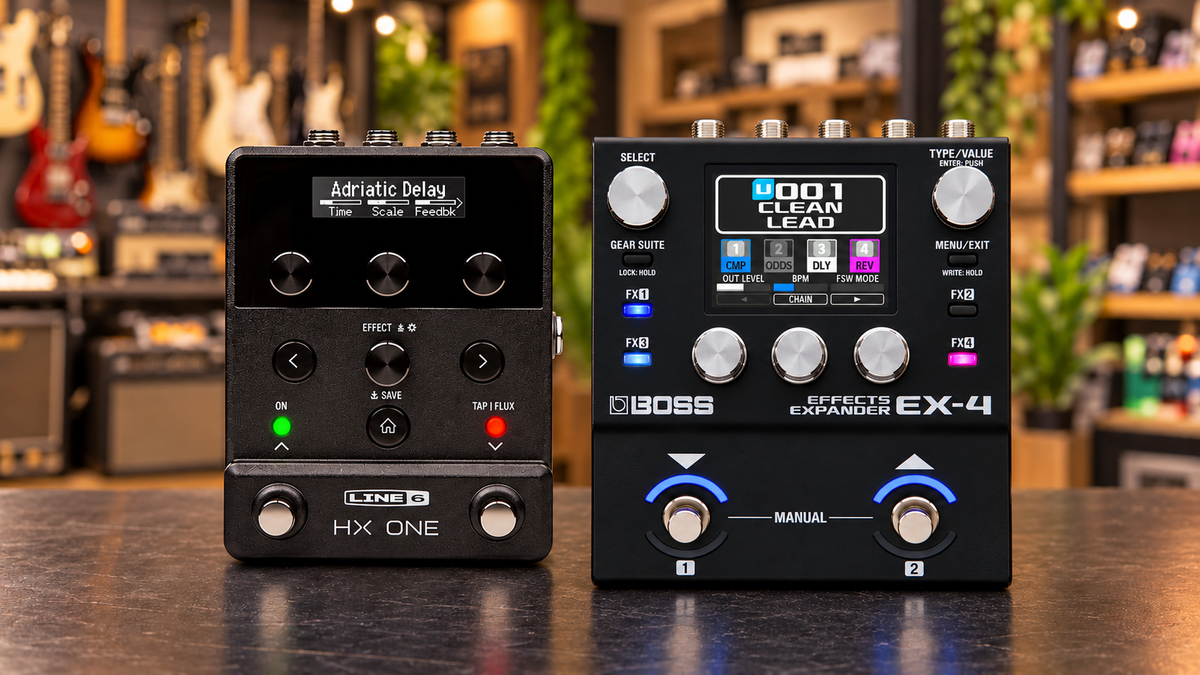
The new BOSS EX-4 Effects Expander and the Line 6 HX One solve a familiar pedalboard problem: how do you gain access to more sounds without filling your board with pedals you may only use occasionally?
Both units are compact, stereo-capable and designed to complement an existing setup. However, the way they work is noticeably different. The BOSS EX-4 can combine up to four effects, while the Line 6 HX One concentrates on delivering one selected effect at a time from a larger library.
This guide explains those differences, who each pedal is for and which one is likely to work best in your rig.
View the BOSS EX-4 at Fair Deal Music | View the Line 6 HX One at Fair Deal Music
What is an effects expander?
An effects expander is designed to add more sounds to a pedalboard without necessarily replacing the pedals already on it.
Instead of buying a separate rotary, pitch, tremolo, delay or specialist modulation pedal for every occasional sound, you can use one compact digital unit to cover the gaps in your setup.
This makes an effects expander particularly useful for cover bands, session musicians, home-recording setups and players whose set lists move between several musical styles.
What is the BOSS EX-4?
The BOSS EX-4 Effects Expander is built for musicians who already have the foundations of a pedalboard but want considerably more flexibility around them.
It contains 120 BOSS guitar and bass effects and can run up to four effects simultaneously. Multiple instances of the same effect can also be used, opening up combinations such as stacked drives, dual delays or layered modulation and ambience.
Its serial, parallel and wet/dry routing options make it possible to create more imaginative signal paths than a simple row of four conventional pedals.
Why four simultaneous effects matter
Many useful sounds depend on combinations rather than one effect working alone. A spacious clean patch might need compression, chorus, delay and reverb, while a more experimental sound could combine pitch, modulation, rhythmic slicing and ambience.
The EX-4 allows these combinations to be saved as complete memories, making it well suited to live sets in which several sounds need to be recalled quickly.
What is the Line 6 HX One?
The Line 6 HX One takes a different approach. It places more than 250 effects from the Line 6 HX family into a compact stereo pedal, but operates one selected effect at a time.
Think of it as a highly adaptable wildcard slot. It can be a delay for one song, a rotary effect for another and a pitch, filter, synth or modulation pedal when something less conventional is required.
The HX One also features Line 6’s Flux Controller. This allows several parameters within the active effect to change together over a chosen period of time using a single footswitch press. It can create transitions, sweeps and expressive changes that would normally require an expression pedal or several control movements.
BOSS EX-4 vs Line 6 HX One
| Feature | BOSS EX-4 | Line 6 HX One |
|---|---|---|
| Core purpose | Build compact multi-effect combinations | Add one changeable specialist effect |
| Effects library | 120 BOSS guitar and bass effects | More than 250 Line 6 HX effects |
| Effects used simultaneously | Up to four | One |
| Saved sounds | 128 preset and 128 user memories | 128 onboard presets |
| External pedal integration | Configurable effects loop | Functions like an individual stereo pedal within the board |
| Signal routing | Serial, parallel and wet/dry configurations | Mono or stereo input and output |
| Special control feature | Four effect blocks, Gear Suite and flexible assignments | Flux Controller for timed parameter changes |
| MIDI | TRS MIDI input and output | MIDI input and output/thru |
| External control | Compatible footswitch or expression pedal | Expression pedal, two footswitches or one of each |
| Bypass options | Master bypass control available | True bypass or buffered DSP bypass |
| Best for | Players wanting several effects working together | Players wanting one highly flexible wildcard effect |
Choose the BOSS EX-4 if…
- You want to run several effects together.
- You like the familiar sound and operation of BOSS effects.
- You want to build and save complete effect chains.
- You need serial, parallel or wet/dry routing.
- You want to integrate an existing pedal into a configurable effects loop.
- You play guitar and bass and want one unit that can support both.
The EX-4 occupies a useful middle ground. It offers substantially more layering and routing than a single-effect pedal without becoming a large floor-based processor.
Explore the BOSS EX-4 Effects Expander

Choose the Line 6 HX One if…
- You only need one additional effect at a time.
- You want the widest possible choice of effects in a compact space.
- You are looking for unusual sounds that may only appear in one or two songs.
- You want true or buffered bypass options.
- You want to use Flux to create evolving or timed parameter changes.
- You need a compact stereo pedal that can move between different roles.
The HX One is particularly effective when your existing board already covers your core sounds. Instead of dedicating valuable space to several occasional effects, one HX One can change roles whenever required.
![Line 6 HX One [Ex-Display] - Fair Deal Music](https://cdn.shopify.com/s/files/1/0441/6457/9484/files/206428-334686-Line-6-HX-One-Effects-Unit-1_1.jpg?v=1739983055)
Which pedal is better for live performance?
For live sets requiring complete combinations of effects, the BOSS EX-4 has the advantage. Its four effect blocks and user memories allow a combination of drive, modulation, delay and reverb to be recalled together.
If your main board already handles those combinations and you simply need one different sound for each song, the Line 6 HX One may be the more direct solution. Its larger effects library and compact single-effect format make it an extremely capable utility pedal.
Which pedal is better for experimental sounds?
Both are strong choices, but they encourage different kinds of experimentation.
The EX-4 is better for combining and routing several effects. Parallel processing, wet/dry setups, stacked effects and multiple instances of the same effect provide plenty of sound-design potential.
The HX One focuses more closely on manipulating one effect. Its Flux Controller can move several parameters between two sets of values, creating dramatic transitions and evolving textures from a single footswitch.
Can either pedal replace your existing pedalboard?
They can replace individual effects, but neither product needs to replace the pedals you already enjoy.
The EX-4 is deliberately designed to integrate with an existing board, including the option to place an external pedal within its effect chain. The HX One behaves more like an individual stompbox whose identity can be changed whenever a different effect is needed.
If you want a complete rig replacement with amp and speaker modelling, a more comprehensive floor processor may be the better option. These two pedals are primarily about expanding a traditional setup.
Practical ways to use the BOSS EX-4
- Complete song presets: Save several effects together for different sections of a live set.
- Ambient soundscapes: Combine modulation, delay and reverb using flexible routing.
- Compact fly rigs: Cover more sounds while reducing the number of individual pedals required.
- Bass pedalboards: Access bass-compatible effects, noise suppression and flexible processing.
- MIDI-controlled rigs: Recall memories and assignments from a compatible switching system.
Practical ways to use the Line 6 HX One
- The wildcard slot: Change from rotary to pitch, delay or synth effects between songs.
- Rarely used effects: Avoid buying several separate pedals for sounds needed occasionally.
- Flux transitions: Create gradual or dramatic parameter changes with one footswitch press.
- Stereo setups: Position the HX One among other stereo pedals, keyboards or processors.
- External control: Add an expression pedal, additional footswitches or MIDI commands.
BOSS EX-4 and Line 6 HX One FAQs
What is the main difference between the BOSS EX-4 and Line 6 HX One?
The BOSS EX-4 can run up to four internal effects simultaneously. The Line 6 HX One runs one selected effect at a time but offers a larger library containing more than 250 effects.
Which has more effects?
The HX One has the larger total library, with more than 250 effects. The EX-4 contains 120 BOSS effects but can combine up to four of them in one chain.
Can the HX One run several effects simultaneously?
No. The HX One is designed to run one selected effect at a time. Its strength is being able to change the role of that single effect slot whenever needed.
Can the BOSS EX-4 run two copies of the same effect?
Yes. The EX-4 supports multiple instances of the same effect as part of its four available effect blocks.
Are both pedals suitable for bass?
Yes. The EX-4 includes bass-compatible BOSS effects, while the HX One can accept guitar, bass, keyboards and other compatible mono or stereo sources.
Do both pedals support MIDI?
Yes. Both can be integrated with compatible MIDI controllers and switching systems, although their connector formats and available commands differ.
Do they come with power supplies?
Yes. The BOSS EX-4 includes a BOSS PSA-S Series adaptor, while the HX One includes a compatible Line 6 9V power supply.
Which is best for a small pedalboard?
The HX One is ideal if you have room for one flexible effect slot. The EX-4 requires slightly more space but provides four simultaneous effects, memories and more advanced internal routing.
FDM Expert Verdict
Choose the BOSS EX-4 when you want to build complete combinations of effects. Choose the Line 6 HX One when you want one pedal that can become almost any individual effect.
The new EX-4 is likely to attract players who have considered the HX One but need more than one effect operating at once. The HX One remains a strong choice for musicians who value a larger effects library, compact dimensions and its distinctive Flux control.
Neither is universally better. They are two different answers to the same pedalboard problem, and the right choice depends on whether you need depth from one effect or several effects working together.
Shop the BOSS EX-4 | Shop the Line 6 HX One
Why Thousands of Musicians Choose Fair Deal Music
When you buy from Fair Deal Music, you’re choosing one of the UK’s most established, independent family run music retailers since 1987.
- Friendly advice from experienced musicians
- New equipment from leading musical instrument brands
- Carefully checked products and secure UK delivery
- Competitive prices and flexible finance options, subject to status
- Helpful support before and after your purchase
- A real Birmingham city-centre store you can visit
Buy • Sell • Trade
Have pedals or music equipment you no longer use? Fair Deal Music buys, sells and part-exchanges pre-owned gear. Trade in your existing equipment and put its value towards the BOSS EX-4 or Line 6 HX One.
Contact our team for a valuation or visit Fair Deal Music at 79–83 Holloway Head, Birmingham.

Share:
Roland GO:KEYS 3 Minion Buyer’s Guide: A Seriously Fun Keyboard