
JHS Pedals 3 series Octave Reverb
Pairs well with
JHS Pedals 3 series Octave Reverb
Description
Quick Product Summary
The JHS Pedals 3 Series Octave Reverb combines spacious ambient reverb with pitch-shifted octave textures, giving you everything from subtle atmospheric depth to expansive shimmer and darker octave-down soundscapes.
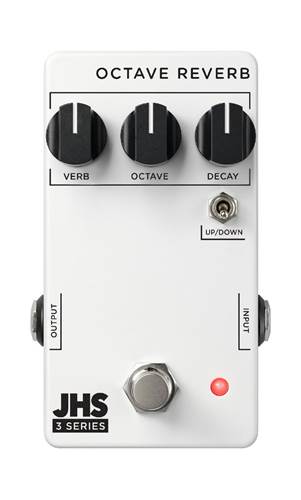
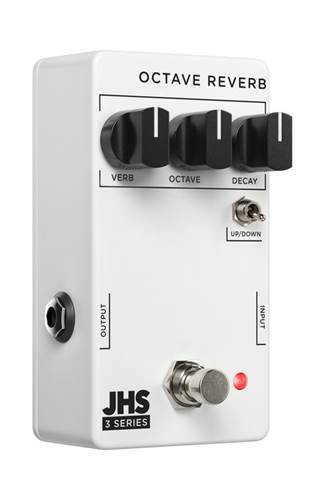
Its simple control layout keeps the creative possibilities easy to reach. Verb controls the amount of reverb, Octave determines how strongly the pitch-shifted signal appears within the reverb, and Decay adjusts how long the reverb trail continues. A dedicated Up/Down toggle then lets you choose whether the reverb carries an octave above or an octave below your original signal.
Octave Up creates the bright, spacious shimmer effect often associated with ambient and cinematic guitar, while Octave Down moves into darker, deeper and more dramatic territory. For players looking for an accessible ambient reverb without menus, presets or complicated secondary functions, the 3 Series Octave Reverb offers a lot of creative range from just three knobs and one switch.
At A Glance
| Feature | Details |
|---|---|
| Brand | JHS Pedals |
| Model | 3 Series Octave Reverb |
| Condition | New |
| Product Type | Octave / shimmer reverb pedal |
| Controls | Verb, Octave, Decay |
| Octave Modes | One octave up / one octave down |
| Main Appeal | Ambient reverb with adjustable pitch-shifted trails |
| Best For | Ambient, worship, post-rock, shoegaze, indie and cinematic guitar |
| Power | 9V DC centre negative |
| Current Draw | 65mA |
What's Included?
-
✓ 1 x JHS Pedals 3 Series Octave Reverb Pedal
Fair Deal Quality Control Assessment
New effects pedals supplied by Fair Deal Music are checked with practical musicianship in mind, including control operation, switching, connections and general signal performance.
With the 3 Series Octave Reverb, particular attention is given to the interaction between the Verb, Octave and Decay controls and the Up/Down selector. The octave effect is designed to appear within the reverb trail rather than simply behaving like a conventional standalone octave pedal.
Why Choose The JHS 3 Series Octave Reverb?
Shimmer Reverb Without Menu Diving
Many ambient reverb pedals provide large banks of algorithms, presets and secondary controls. The 3 Series Octave Reverb takes a much more immediate approach, putting its core sound directly under three knobs and one toggle.
Upper And Lower Octave Reverb
The Up/Down toggle significantly changes the character of the effect. Octave Up creates brighter, soaring shimmer textures, while Octave Down produces deeper, more ominous ambience.
Adjustable Octave Blend
The dedicated Octave control lets you decide how strongly the pitch-shifted element appears in the reverb. Lower settings keep the effect subtle, while higher settings make the octave character a major part of the sound.
From Short Ambience To Long Soundscapes
The Decay control adjusts the length of the reverb trail, making the pedal useful for restrained background space as well as long, evolving pads and atmospheric textures.
JHS 3 Series Octave Reverb vs Popular Reverb Alternatives
JHS 3 Series Octave Reverb vs JHS 3 Series Reverb
The standard JHS 3 Series Reverb is better suited to players wanting a flexible general-purpose reverb with tonal shaping and pre-delay options. The Octave Reverb is more specialised, adding pitch-shifted content directly into the reverb trail for ambient and shimmer-style sounds.
JHS 3 Series Octave Reverb vs JHS 3 Series Hall Reverb
The 3 Series Hall Reverb focuses on the impression of very large acoustic spaces, with long, expansive hall-style decay. Choose the Hall Reverb for a more traditional large-space effect and the Octave Reverb when pitch-shifted ambience is an important part of the sound.
JHS 3 Series Octave Reverb vs BOSS RV-6
The BOSS RV-6 provides a much wider selection of reverb types, including conventional room, hall and plate sounds alongside shimmer and other modes. It is the stronger option for players wanting one compact pedal to handle many different reverb jobs. The JHS is more focused and considerably simpler to operate when octave reverb is the sound you actually want.
JHS 3 Series Octave Reverb vs Electro-Harmonix Oceans 11
The EHX Oceans 11 offers eleven different reverb types and much deeper secondary functionality, including its own shimmer setting. The 3 Series Octave Reverb is better suited to players who prefer immediate controls and specifically want octave-up and octave-down ambience without navigating a multi-mode pedal.
Who Is The JHS 3 Series Octave Reverb For?
The 3 Series Octave Reverb is particularly well suited to:
-
Ambient and atmospheric guitarists
-
Players wanting an accessible shimmer reverb
-
Worship musicians building spacious clean sounds
-
Shoegaze and post-rock players using long effect chains
-
Guitarists interested in octave-down atmospheric textures
-
Musicians who prefer simple physical controls to menus and presets
-
Home-recording players creating pads and cinematic guitar layers
-
Pedalboard users wanting a specialist ambient effect without a large footprint
Looking for advice on choosing the right reverb, delay or ambient pedalboard setup? Our experienced team of musicians can help by phone, online or in our Birmingham showroom.
Suitable Genres & Uses
Ambient guitar: Turn up Decay and gradually introduce Octave for large, sustained reverb washes that can fill space behind sparse melodic playing.
Worship guitar: Octave Up can create bright shimmer textures underneath clean arpeggios and volume-sweller parts without requiring a complex multi-effects system.
Shoegaze: Higher Verb and Decay settings work particularly well alongside fuzz, modulation and delay for dense layers of atmospheric guitar.
Post-rock: Use long octave reverb trails behind repeating guitar figures and delay patterns to create a wider sense of scale.
Cinematic textures: Octave Down adds darker pitch-shifted content to the reverb, making it useful for dramatic drones, soundtrack-style guitar and less conventional ambient parts.
Subtle rhythm ambience: Keep Octave and Decay relatively restrained to add movement and depth without turning every chord into a large atmospheric wash.
What Is Octave Reverb And How Is It Different From Normal Reverb?
Normal reverb creates the impression of sound reflecting within a physical or simulated space. An octave reverb adds pitch-shifting to those reflections, meaning the reverb trail can contain notes above or below the pitch you originally played.
On the JHS 3 Series Octave Reverb, the octave is blended into the reverb decay, rather than simply placing a standard octave effect over the entire dry guitar signal. That difference is what produces the floating, evolving character associated with shimmer-style ambience.
Octave Up vs Octave Down: Which Should You Use?
Octave Up
The upper-octave setting produces a brighter, more spacious sound. It works particularly well for clean arpeggios, ambient swells, sustained lead notes and parts where you want the reverb to rise above the original guitar.
Octave Down
The lower-octave setting creates a deeper and darker response. It can make simple chords sound larger and more ominous and works particularly well for experimental, cinematic, post-rock and heavier ambient textures.
Neither setting is inherently better; they perform very different musical jobs.
Story & Context
Pitch-shifted reverb developed from studio experimentation in which reverb and pitch processing were combined to create sounds that could not occur naturally in an acoustic room.
The effect became closely associated with ambient production techniques in the late 1970s and early 1980s, where pitch-shifted signals were fed into reverberation to create long, harmonically rich textures. This approach eventually became widely known among guitarists as shimmer reverb.
JHS developed the 3 Series Octave Reverb as a straightforward interpretation of that concept. Rather than building a large multi-algorithm reverb workstation, the design concentrates entirely on blending octave information into the reverb decay.
The addition of both upper and lower octave settings gives it more creative range than a shimmer pedal limited to bright octave-up textures, while retaining the deliberately simple philosophy of the wider JHS 3 Series.
Technical Specifications
| Specification | Details |
|---|---|
| Brand | JHS Pedals |
| Model | 3 Series Octave Reverb |
| Effect Type | Octave / shimmer reverb |
| Controls | Verb, Octave, Decay |
| Toggle | Up / Down |
| Upper Mode | Adds one-octave-up content to the reverb |
| Lower Mode | Adds one-octave-down content to the reverb |
| Input | ¼-inch |
| Output | ¼-inch |
| Power Requirement | 9V DC centre negative |
| Current Draw | 65mA |
| Length | 4.42" |
| Width | 2.38" |
| Height | 1.22" |
| Manufactured In | Kansas City, Missouri, USA |
Power Requirements
The JHS Pedals 3 Series Octave Reverb requires a regulated 9V DC centre-negative power supply capable of providing at least 65mA.
Use the specified 9V operating voltage with a suitable pedalboard power supply.
Fair Deal Music Verdict 🎵
★★★★★ 5/5
The JHS Pedals 3 Series Octave Reverb is a strong option for guitarists who want to explore shimmer and ambient reverb without committing to an expensive, menu-heavy multi-reverb pedal.
Its biggest strength is how quickly you can shape the effect. Verb controls the overall amount of space, Octave determines how obvious the pitch shifting becomes, and Decay decides whether the result is a short atmospheric tail or a long evolving wash. The Up/Down switch then completely changes the mood.
Best suited for: Ambient, post-rock, shoegaze and worship players wanting simple octave-based reverb.
Customers usually upgrade from: Basic room or hall reverbs when they want more atmospheric and pitch-shifted textures.
Most commonly paired with: Delay, chorus, tremolo, volume pedals, overdrive and fuzz.
Our tip: Start with Octave lower than you expect. A small amount of pitch shifting inside a longer reverb can often sound larger and more musical than turning every control towards maximum.
Showroom feedback: The octave-down setting deserves just as much attention as the traditional shimmer sound. It can transform simple chord voicings into much darker and more cinematic textures.
Why Buy From Fair Deal Music?
When you buy from Fair Deal Music, you're choosing one of the UK's most established, independent family run music retailers since 1987.
Our Birmingham showroom and knowledgeable musician-led team give you access to friendly, practical advice before and after your purchase. Whether you're choosing your first reverb, building an ambient pedalboard or working out how delay and modulation should interact with your reverb, we're happy to help you find equipment that suits the way you actually play.
When you shop with Fair Deal Music, you can buy with confidence thanks to:
-
Expert advice from knowledgeable musicians
-
Carefully checked new, used, pre-owned and ex-display equipment
-
Competitive prices on leading music brands
-
Secure online ordering
-
UK-wide delivery
-
Friendly support before and after your purchase
-
Decades of experience with new and pre-owned musical equipment
-
A large Birmingham showroom where you can speak directly with our team
Trade In. Trade Up. Save More.
Thinking about upgrading? Your next piece of gear could cost less than you think.
We're always happy to consider part exchanges and trade-ins on a wide range of musical instruments and equipment. Whether you're looking to upgrade your guitar, amplifier, effects or other equipment, your existing gear could help reduce the cost of your next purchase.
Simply get in touch with our team for a no-obligation valuation, and we'll be happy to discuss the options available.
It's an easy way to unlock the value of equipment you no longer use while making your next purchase even more affordable.
Frequently Asked Questions
What does the Octave control do on the JHS 3 Series Octave Reverb?
The Octave knob determines how much pitch-shifted signal is blended into the reverb. Lower settings create a subtler effect, while higher settings make the octave content much more prominent.
What does the Up/Down switch do?
The switch selects whether the octave element within the reverb is pitched one octave above or one octave below the original note.
Is the 3 Series Octave Reverb a shimmer pedal?
Yes. Its octave-up mode creates the bright pitch-shifted reverb commonly described as shimmer, while the octave-down option gives you a darker variation on the concept.
Can I use it as a normal reverb?
Reducing the Octave control allows the reverb element to become much more dominant, making the pedal useful for more restrained ambience as well as obvious octave effects.
Is the octave applied to my dry guitar signal?
The pedal is designed around blending octave information into the reverb trail, which gives it a different feel from running a conventional octave pedal directly over the whole guitar sound.
Is the octave-down mode useful for heavy music?
Yes. Lower-octave reverb can add depth and an ominous atmosphere around slower riffs, sustained chords and lead lines, particularly when combined with distortion or fuzz.
Where should I place the Octave Reverb in my pedal chain?
A good starting point is towards the end of the chain, after overdrive, distortion and modulation. Placing delay before the reverb can create particularly large ambient sounds. More experimental setups may benefit from trying reverb earlier in the chain.
Is the JHS 3 Series Octave Reverb suitable for beginners?
Yes. The three-knob layout makes the pedal straightforward to understand, while the octave selector provides enough tonal variation to remain useful as a pedalboard develops.
The JHS Pedals 3 Series Octave Reverb is an excellent choice for players who want to move beyond conventional reverb and start creating larger, more atmospheric guitar sounds. With adjustable reverb, octave blend and decay plus both upper and lower octave modes, it offers a surprisingly wide creative range without sacrificing the straightforward operation that makes the 3 Series so appealing.
If you have any questions, you are always welcome to contact us. We'll get back to you as soon as possible, within 24 hours on weekdays.
-
Shipping Information
Use this text to answer questions in as much detail as possible for your customers.
-
Customer Support
Use this text to answer questions in as much detail as possible for your customers.
-
FAQ’s
Use this text to answer questions in as much detail as possible for your customers.
-
Contact Us
Use this text to answer questions in as much detail as possible for your customers.
Good to Know
How long is the warranty period?
For new products, you will get the full manufacturer warranty. For our second-hand products, we will cover any fault within 4 weeks of the purchase of any guitar. For pianos, that will be extended to 3 months.
What is the estimated delivery time?
We use the 24hr delivery in UK mainlands if it can be delivered by post. For Scotland and Wales, it depends on the area and the distance from our warehouse, but our aim is to get you order to your hands as soon as possible.
For products that cannot be posted, we will arrange the delivery with you to suit your schedule and deliver it to you
Do you offer international shipping?
We usually can ship instruments worldwide. Please get in touch to get a quote
What is the maintinance on your USED products?
- Guitars: Every guitar will be setup to a high playing standard before shipping. The electronics are checked and if there is any issue with guitar, it will be fixed.
- Pianos: Every piano is fully tested to make sure it's fully functional, cleaned, and if it's digital, a facroty reset is performed.
Do you offer assembly and installation?
We offer installation and assembly for pianos, drum kits, or any products that require it for and extra charge. Please get in touch so we can provide you with a quote.