

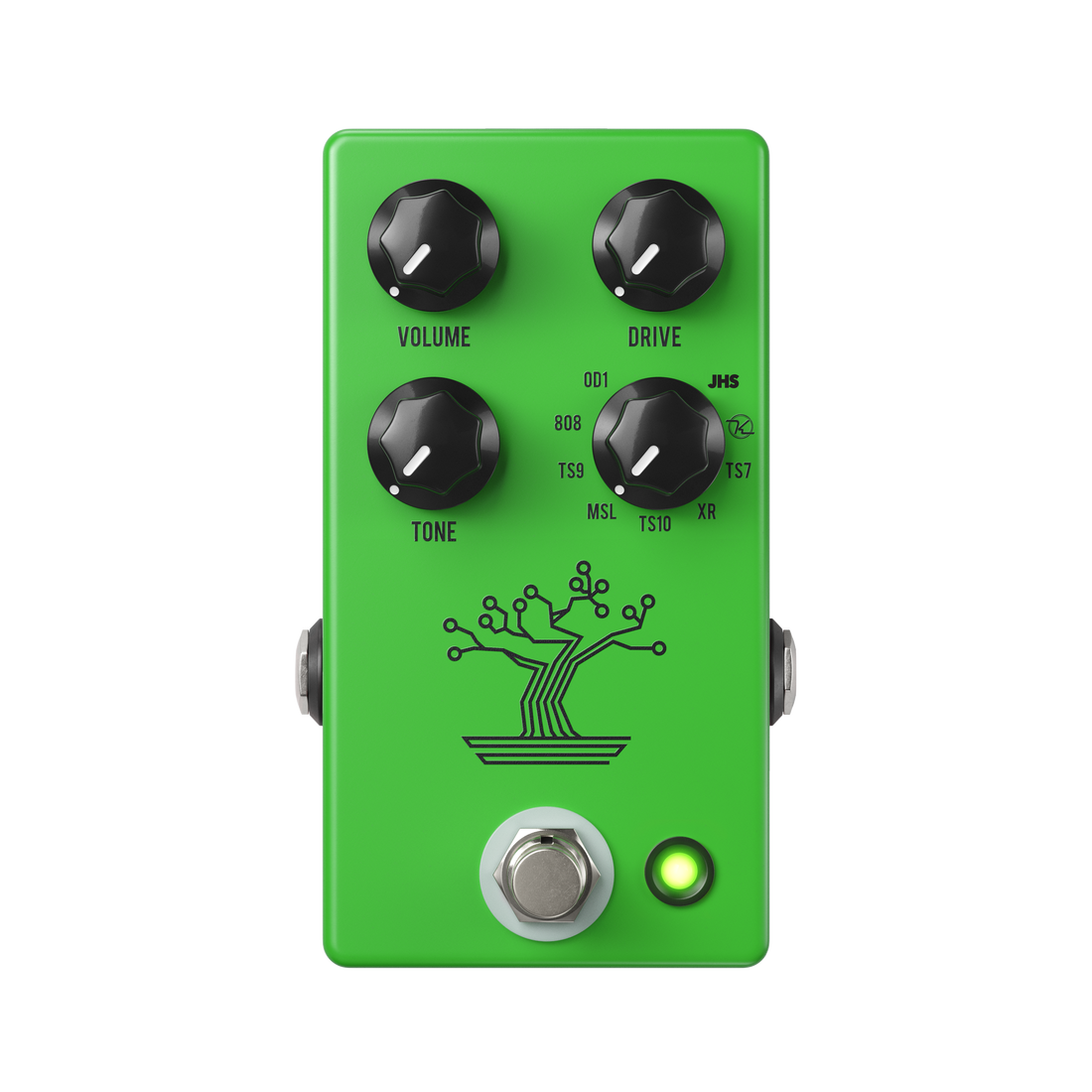
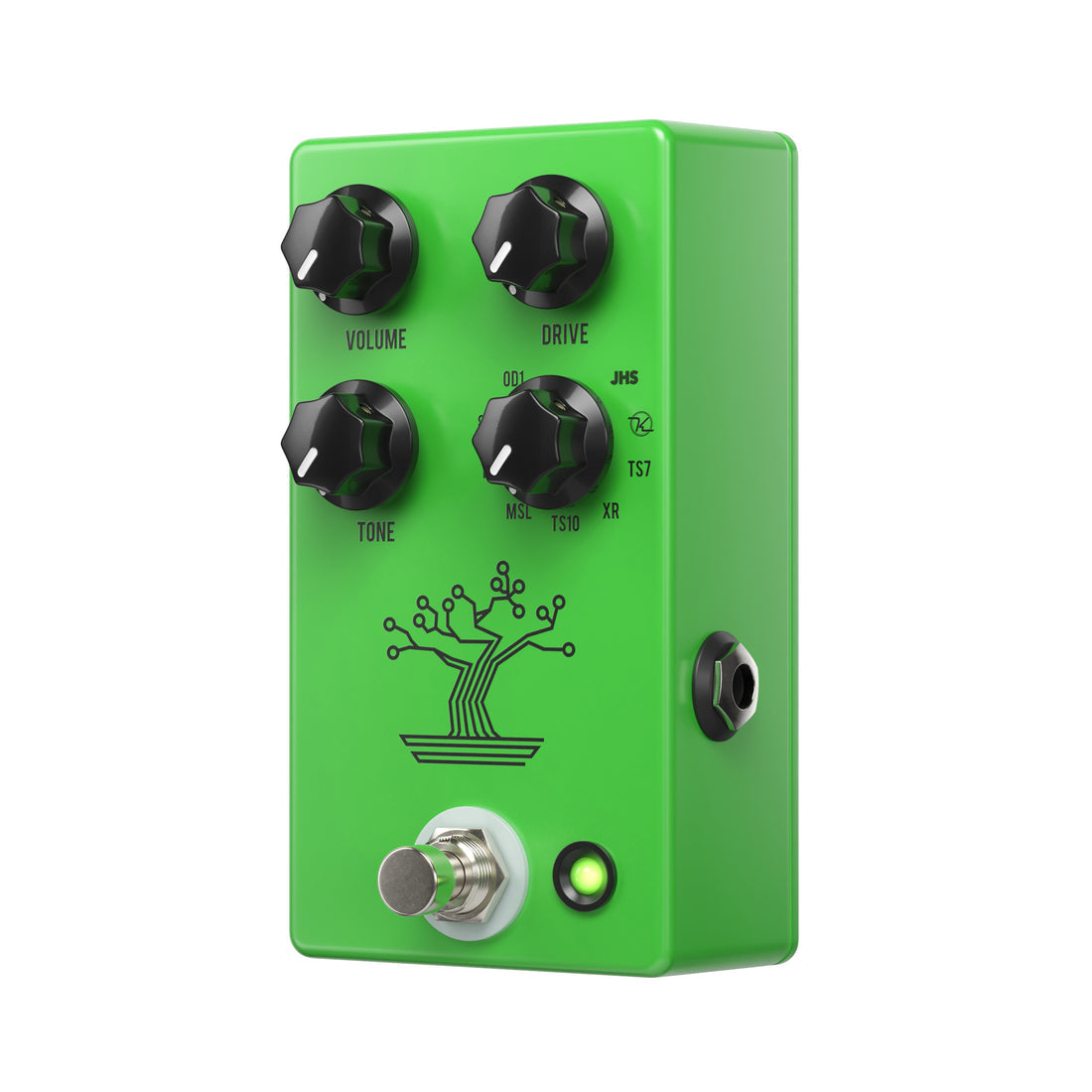
JHS Pedals Bonsai 9-Way Overdrive Pedal
Pairs well with
JHS Pedals Bonsai 9-Way Overdrive Pedal
Description
Quick Product Summary
The JHS Pedals Bonsai brings nine important variations of one of the most influential overdrive circuits ever created together in a single pedal. Instead of giving you one interpretation of the familiar mid-focused Screamer sound, the Bonsai lets you explore different generations, rare versions and modified examples at the turn of a rotary selector.
The nine modes range from the brighter asymmetrical character of the 1977 OD-1 through classic TS-808 and TS-9 sounds, later TS-10 and TS-7 variations, rarer circuits and two well-known modified versions. Each has its own feel, gain structure, low-end response and midrange character, making the Bonsai much more than nine minor EQ variations of the same sound.
JHS approached the Bonsai as a circuit-replication project rather than a digital modelling exercise. Components specific to each selected mode are brought into the analogue circuit, making it an excellent choice for guitarists who love classic mid-focused overdrive but want considerably more choice from one pedalboard position.
At A Glance
| Feature | Details |
|---|---|
| Brand | JHS Pedals |
| Model | Bonsai |
| Condition | New |
| Product Type | Multi-mode analogue overdrive pedal |
| Modes | 9 |
| Main Appeal | Nine classic Screamer-family overdrive circuits in one pedal |
| Best For | Blues, rock, country, pop, alternative, lead boost and tightening high-gain amps |
| Headline Feature | Nine-position circuit selector |
| Power | 9V DC centre negative |
What's Included?
-
✓ 1 x JHS Pedals Bonsai 9-Way Overdrive Pedal
Fair Deal Quality Control Assessment
New effects pedals supplied by Fair Deal Music are checked with practical musicianship in mind, including control operation, switching, connections and general signal performance.
With the Bonsai, particular attention is naturally given to the nine-position selector because each setting engages a different variation of the circuit. The pedal is designed so that changing modes does more than alter a simple EQ preset; gain character, clipping response, frequency balance and playing feel can change from one position to another.
Why Choose The JHS Bonsai?
Nine Classic Overdrive Voices In One Pedal
The Bonsai lets you explore nine distinct variations without dedicating an entire pedalboard to different green overdrives. From classic low-gain mid push to hotter, fuller and modified sounds, it covers a substantial part of the circuit's history.
Analogue Circuit Replication
This is not simply a digital model selector. JHS studied individual pedals and recreated their circuit characteristics, with mode-specific components brought into the signal path depending on the selected position.
Ideal For Finding Your Favourite Screamer Sound
Some players prefer the smooth TS-808 response, others favour the stronger low mids of a TS-9, while another guitar and amplifier combination might work better with the cleaner JHS Strong Mod or higher-gain TS-7 mode. The Bonsai lets you make those comparisons using one pedal and one rig.
Excellent As An Amp Or Drive Booster
The classic mid-focused overdrive format remains particularly useful for pushing an already driven amplifier or stacking into another gain pedal. Lower Drive and higher output settings can tighten the low end, emphasise the guitar's midrange and add saturation without simply piling on excessive distortion.
The Nine JHS Bonsai Modes
OD-1 – 1977
A brighter, slightly higher-gain voice with asymmetrical clipping. The Tone control is bypassed in this mode, reflecting the simpler architecture of the original design. It is especially effective for pushing another drive pedal or an already working amplifier.
TS-808 – 1979
The classic low-gain Screamer voice, with the pronounced midrange character that helped establish this style of overdrive as a pedalboard standard.
TS-9 – 1982
Closely related to the TS-808 but with a slightly stronger low-mid character. A useful choice when you want familiar mid-focused drive with a touch more body.
MSL / Power / L Series – 1985
A higher-gain variation with additional low end and a softer, thicker response. Despite its Metal Screamer heritage, it is much broader than a modern extreme-metal distortion sound.
TS-10 – 1986
A crisp, relatively low-gain variation with more low-end roll-off. It works particularly well for articulate blues, lead boosting and situations where you want the classic mid emphasis without too much extra bass.
EXAR OD-1 – 1989
Based on a Polish TS-style overdrive with a different gain character, slightly more drive and a somewhat more open response than several of the traditional Screamer modes.
TS-7 Hot Mode – 1999
The highest-gain option in the Bonsai. Extra dirt and low end make this a strong setting when a traditional low-gain Screamer does not provide enough saturation on its own.
Keeley Mod Plus – 2002
A recreation of Robert Keeley's well-known modification, with increased bass response and a smoother approach to the midrange and upper frequencies.
JHS Strong Mod – 2008
JHS's own modified interpretation. This setting is cleaner and more powerful, making it particularly useful when you want the Bonsai to operate as a strong boost rather than relying primarily on pedal-generated distortion.
JHS Bonsai vs Popular Overdrive Pedal Alternatives
JHS Bonsai vs Ibanez TS808
The Ibanez TS808 is the straightforward choice if you specifically want the traditional Tube Screamer sound and have no need to explore multiple variations. The Bonsai includes its own carefully replicated TS-808 mode but adds eight additional voices, making it better suited to players who want to compare different eras and modified versions within one pedal.
JHS Bonsai vs Ibanez TS9
The Ibanez TS9 provides the familiar three-control layout and classic TS9 response in a dedicated pedal. Choose it if that particular sound is already exactly what you need. Choose the Bonsai when you want the TS-9 character alongside earlier, later and modified circuit variations without changing pedals.
JHS Bonsai vs JHS 3 Series Screamer
The JHS 3 Series Screamer focuses specifically on the JHS Strong Mod concept, providing extra clean headroom and a versatile take on the Screamer format in a simpler pedal. It is the better choice if you know that modified JHS sound is what you want. The Bonsai is the more comprehensive option when comparing nine different circuit personalities is the priority.
JHS Bonsai vs EarthQuaker Devices Plumes
The EarthQuaker Devices Plumes takes the Screamer concept in a more modern direction with three clipping modes, increased clarity and its own broader tonal personality. The Bonsai instead focuses on reproducing historically important variations of the circuit. Choose the Plumes for a modern reinterpretation; choose the Bonsai for breadth across classic and modified Screamer sounds.
Who Is The JHS Bonsai For?
The Bonsai is particularly well suited to:
-
Guitarists who love mid-focused overdrive but cannot settle on one version
-
Blues and rock players wanting classic low-to-medium gain tones
-
Players who use overdrive to push a valve amplifier
-
High-gain guitarists wanting tighter bass and stronger midrange definition
-
Session musicians who need several overdrive flavours from one pedalboard position
-
Pedal collectors interested in important variations of the Screamer circuit
-
Guitarists regularly switching between single coils, P-90s and humbuckers
-
Players who stack overdrives and want different responses for different combinations
Looking for advice on choosing the right overdrive, boost or gain-stacking setup? Our experienced team of musicians can help by phone, online or in our Birmingham showroom.
Suitable Genres & Uses
Blues: Lower-gain modes provide the smooth sustain and focused midrange that work particularly well for expressive blues rhythm and lead playing.
Classic rock: Use the Bonsai into a clean or lightly breaking-up amplifier to add crunch, or push an already driven amp for a thicker and more compressed response.
Country: Lower Drive settings and brighter modes can add definition and push without turning articulate picking into heavy distortion.
Alternative and indie: The different circuit voices make it easier to find an overdrive that complements unusual amplifiers, fuzz pedals and layered guitar arrangements.
High-gain rock and metal: Run the pedal with relatively low Drive and increased output before a high-gain amplifier to tighten the bass and put greater emphasis on the guitar's midrange attack.
Lead boost: Use the Bonsai to push an existing rhythm sound forward with additional mids, sustain and output rather than replacing the amplifier's core distortion.
Why Do Tube Screamer-Style Pedals Work So Well For Guitar?
A Screamer-style overdrive deliberately shapes the guitar signal rather than trying to remain completely transparent. Its recognisable midrange emphasis can help electric guitar occupy a useful frequency range in a full band, while the controlled bass response stops driven sounds becoming unnecessarily loose.
That is also why these pedals are so commonly used as boosts. With the Drive reduced and output increased, a Screamer-style circuit can push an amplifier harder while reshaping the frequencies entering it. The Bonsai is particularly useful because its nine modes let you choose how pronounced, tight, bright, thick or aggressive that behaviour becomes.
Story & Context
The circuit family explored by the Bonsai stretches back to the late 1970s. The BOSS OD-1 appeared in 1977 with asymmetrical clipping, followed shortly afterwards by the TS-808 architecture that established the format most guitarists now associate with classic green overdrive pedals.
The design continued evolving through the 1980s and 1990s, producing variations such as the TS-9, Metal Screamer, TS-10 and TS-7. At the same time, independent pedal builders began modifying these circuits to alter headroom, bass response, gain and frequency balance.
JHS took that history and condensed nine selected examples into the Bonsai. Developing the pedal involved studying individual units, including the effect of component tolerances and age, rather than simply working from generic schematics.
The Bonsai debuted at the January 2018 NAMM Show and quickly became one of JHS's most successful releases. Its appeal is straightforward: instead of arguing over which generation or modification is the definitive version, the player can explore nine of them directly.
Technical Specifications
| Specification | Details |
|---|---|
| Brand | JHS Pedals |
| Model | Bonsai |
| Effect Type | Multi-mode analogue overdrive |
| Number Of Modes | 9 |
| Modes | OD-1, TS-808, TS-9, MSL/Power/L Series, TS-10, EXAR OD-1, TS-7 Hot, Keeley Mod Plus, JHS Strong Mod |
| Main Controls | Volume, Tone, Drive |
| Mode Selection | 9-position rotary selector |
| Bypass | Buffered bypass |
| Power Requirement | 9V DC centre negative |
| Current Draw | 20mA |
| Dimensions | 2.6" x 4.8" x 1.6" |
Power Requirements
The JHS Pedals Bonsai requires standard 9V DC centre-negative power and consumes approximately 20mA.
Use a properly regulated pedal power supply delivering the specified voltage.
Fair Deal Music Verdict 🎵
★★★★★ 5/5
The JHS Pedals Bonsai is one of the most useful solutions available for a guitarist who understands why the classic Screamer circuit works but does not want to be restricted to one particular version.
Its real advantage is not simply quantity. The nine modes offer meaningful changes in gain, bass response, mids, clipping character and overall feel, making it possible to choose a setting around the guitar, amplifier and job at hand rather than forcing one Screamer voice to work everywhere.
Best suited for: Guitarists who want the versatility of several classic mid-focused overdrives while using a single pedalboard position.
Customers usually upgrade from: A standard single-mode Screamer-style overdrive when they want to explore different versions without building a collection of near-identical pedals.
Most commonly paired with: Valve amplifiers, distortion pedals, fuzz pedals and other overdrives for gain stacking.
Our tip: Don't judge the modes with Drive set high. Start with lower Drive and higher Volume into an amplifier that is already beginning to break up. The differences in low end, mids and attack become much easier to appreciate.
Showroom feedback: The Bonsai makes the most sense when you compare its modes through your own guitar and amplifier. A setting that sounds only subtly different in isolation can respond very differently once it is pushing an amp or another gain pedal.
Why Buy From Fair Deal Music?
When you buy from Fair Deal Music, you're choosing one of the UK's most established, independent family run music retailers since 1987.
Our Birmingham showroom and knowledgeable musician-led team give you access to friendly, practical advice before and after your purchase. Whether you're choosing your first overdrive, refining an existing pedalboard or looking for the right pedal to push a valve amplifier, we're happy to help you find equipment that works for the way you actually play.
When you shop with Fair Deal Music, you can buy with confidence thanks to:
-
Expert advice from knowledgeable musicians
-
Carefully checked new, used, pre-owned and ex-display equipment
-
Competitive prices on leading music brands
-
Secure online ordering
-
UK-wide delivery
-
Friendly support before and after your purchase
-
Decades of experience with new and pre-owned musical equipment
-
A large Birmingham showroom where you can speak directly with our team
Trade In. Trade Up. Save More.
Thinking about upgrading? Your next piece of gear could cost less than you think.
We're always happy to consider part exchanges and trade-ins on a wide range of musical instruments and equipment. Whether you're looking to upgrade your guitar, keyboard, amplifier, drum kit or studio gear, your existing equipment could help reduce the cost of your next purchase.
Simply get in touch with our team for a no-obligation valuation, and we'll be happy to discuss the options available.
It's an easy way to unlock the value of the gear you no longer use while making your next piece of equipment even more affordable.
Frequently Asked Questions
Is the JHS Bonsai nine pedals in one?
The Bonsai contains nine selectable variations of the Screamer-family circuit. JHS designed the selector to engage components specific to each mode rather than simply applying nine digital EQ presets.
Which JHS Bonsai mode is closest to a classic Tube Screamer?
The TS-808 and TS-9 modes are the obvious starting points for the two most familiar classic sounds. The TS-808 offers the traditional low-gain mid-focused response, while the TS-9 has a slightly stronger low-mid character.
Which Bonsai mode has the most gain?
The TS-7 Hot mode provides the highest-gain sound in the Bonsai, with additional low end and dirt compared with the more traditional lower-gain modes.
Can I use the Bonsai as a boost?
Yes. Lower the Drive and increase the output to use the pedal primarily for level, frequency shaping and pushing another gain stage. The OD-1 and JHS Strong Mod modes are particularly interesting for boost applications.
Is the Bonsai suitable for pushing a high-gain amplifier?
Yes. Screamer-style overdrives are commonly used in front of high-gain amplifiers to reduce excessive bass, focus the mids and sharpen the attack. Experiment with low Drive settings first rather than adding unnecessary extra distortion.
Does the Tone control work in every Bonsai mode?
No. In OD-1 mode, the Tone control is not active, reflecting the design of the original circuit on which that mode is based.
Can the Bonsai work as my main overdrive into a clean amp?
Yes. Several modes provide excellent standalone low-to-medium gain sounds. The ability to change circuit voice also makes it easier to find a mode that complements a particular clean amplifier.
Why choose the Bonsai instead of a normal TS808 or TS9?
If you already know precisely which single Screamer sound you want, a dedicated pedal can be the simpler choice. The Bonsai makes more sense when you want to explore different eras and modifications, use different voices for different guitars or need greater versatility from one pedalboard position.
The JHS Pedals Bonsai is an excellent choice for anyone who appreciates the classic mid-focused overdrive formula but wants to explore how that formula changed across different eras and modifications. Nine distinct circuit voices make it useful as a main overdrive, amp boost or gain-stacking tool without requiring a collection of separate pedals.
If you have any questions, you are always welcome to contact us. We'll get back to you as soon as possible, within 24 hours on weekdays.
-
Shipping Information
Use this text to answer questions in as much detail as possible for your customers.
-
Customer Support
Use this text to answer questions in as much detail as possible for your customers.
-
FAQ’s
Use this text to answer questions in as much detail as possible for your customers.
-
Contact Us
Use this text to answer questions in as much detail as possible for your customers.
Good to Know
How long is the warranty period?
For new products, you will get the full manufacturer warranty. For our second-hand products, we will cover any fault within 4 weeks of the purchase of any guitar. For pianos, that will be extended to 3 months.
What is the estimated delivery time?
We use the 24hr delivery in UK mainlands if it can be delivered by post. For Scotland and Wales, it depends on the area and the distance from our warehouse, but our aim is to get you order to your hands as soon as possible.
For products that cannot be posted, we will arrange the delivery with you to suit your schedule and deliver it to you
Do you offer international shipping?
We usually can ship instruments worldwide. Please get in touch to get a quote
What is the maintinance on your USED products?
- Guitars: Every guitar will be setup to a high playing standard before shipping. The electronics are checked and if there is any issue with guitar, it will be fixed.
- Pianos: Every piano is fully tested to make sure it's fully functional, cleaned, and if it's digital, a facroty reset is performed.
Do you offer assembly and installation?
We offer installation and assembly for pianos, drum kits, or any products that require it for and extra charge. Please get in touch so we can provide you with a quote.