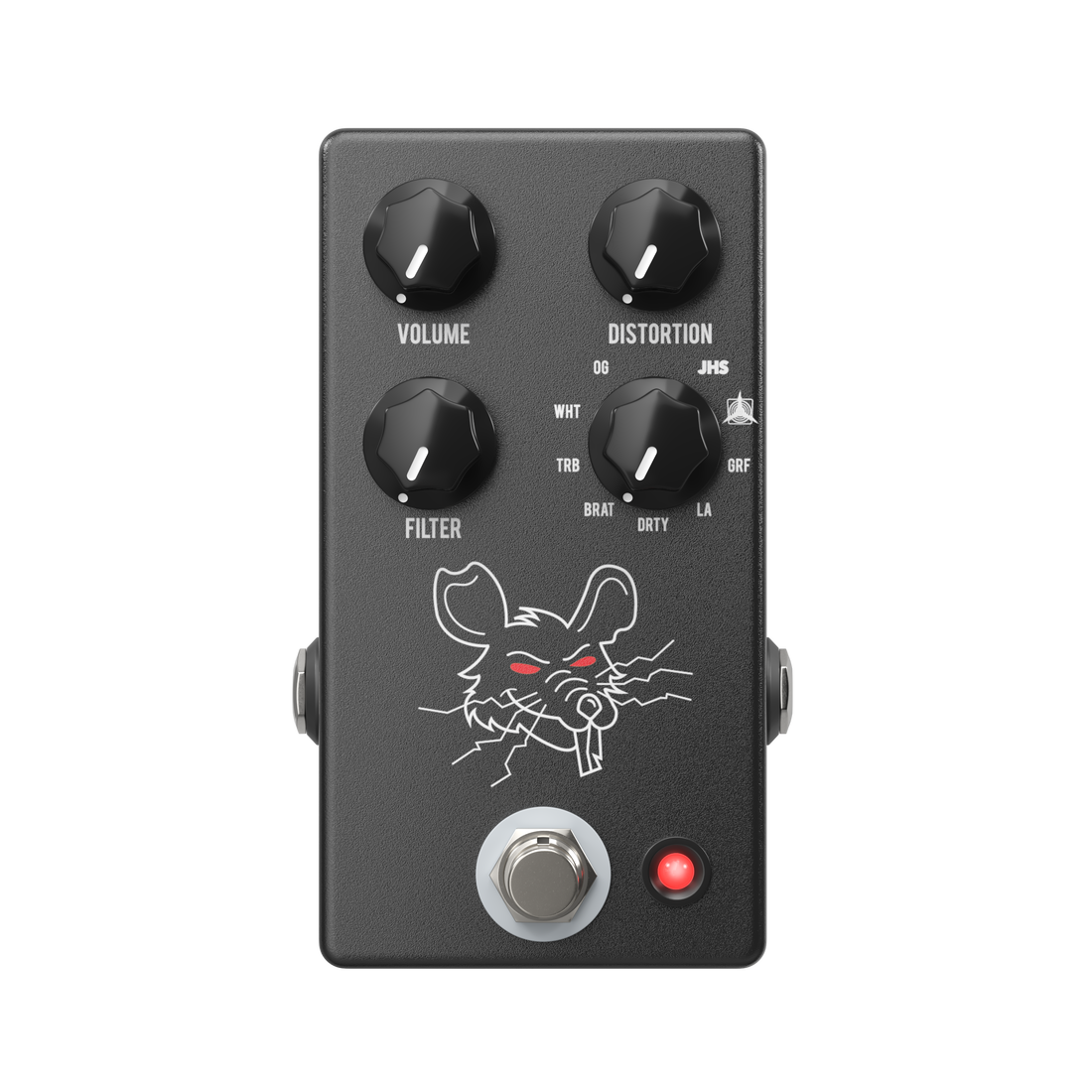
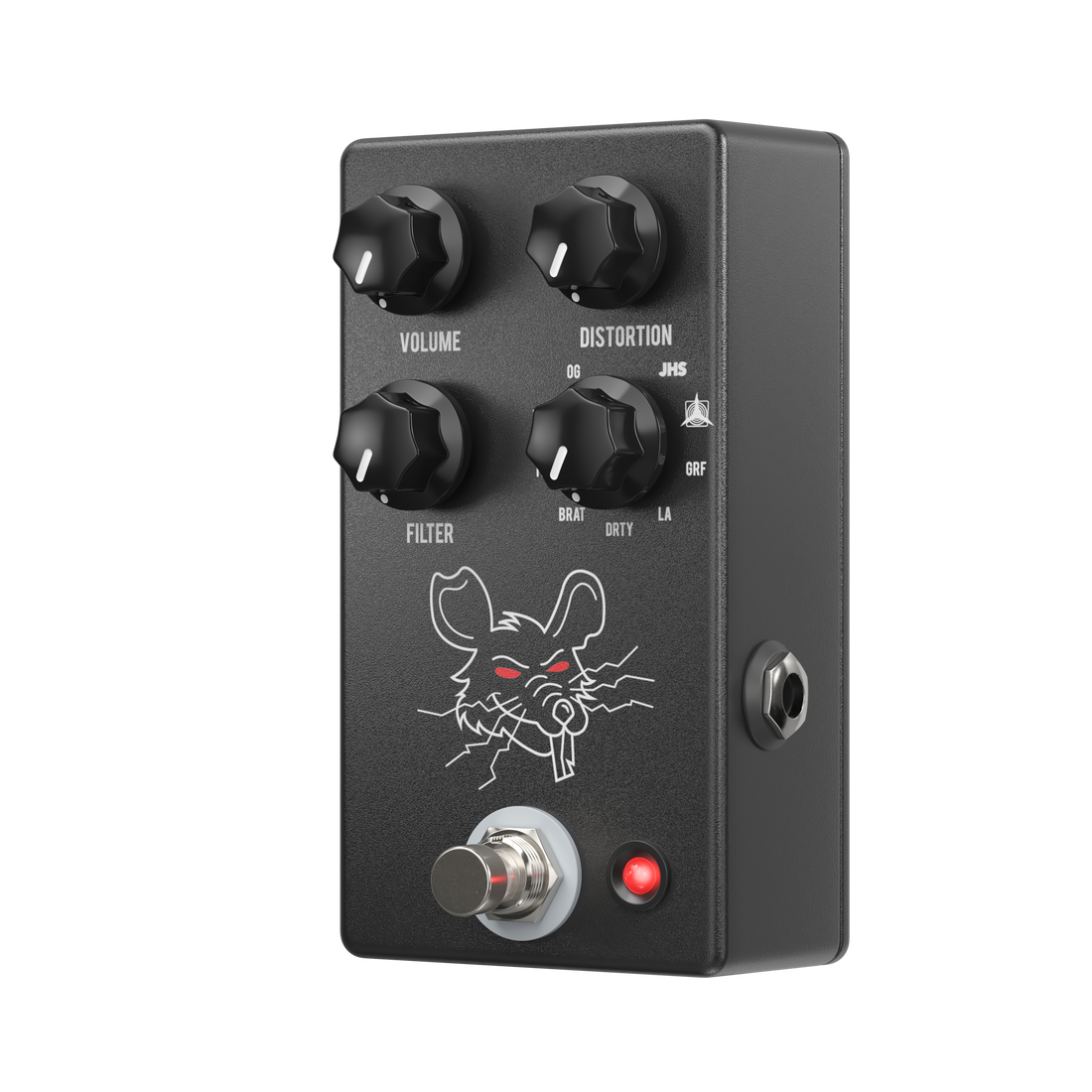
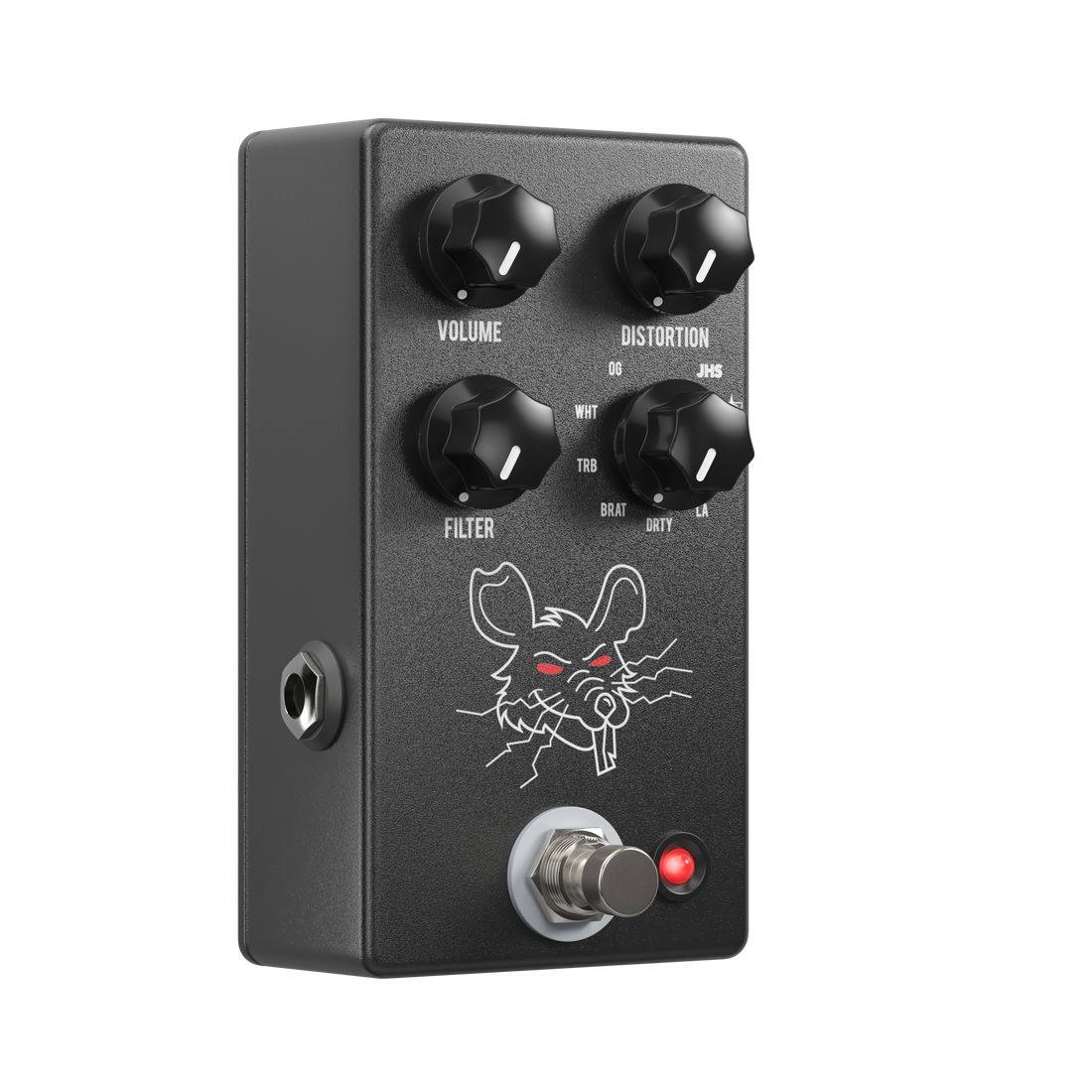
JHS Pedals PackRat 9-Mode Distortion Pedal – Black
Pairs well with
JHS Pedals PackRat 9-Mode Distortion Pedal – Black
Description
Quick Product Summary
The JHS Pedals PackRat in Black brings decades of RAT-style distortion history into one compact pedal. Rather than offering a single interpretation of the famous circuit, it gives you nine distinct analogue modes covering early vintage designs, later production variations, higher-headroom and germanium versions, boutique reinterpretations and JHS's own modified voice.
At its simplest, the PackRat can move from gritty overdrive through thick distortion and into fuzzy, heavily saturated sounds. What makes it special is the ability to change the underlying circuit behaviour while keeping the familiar Volume, Distortion and Filter control layout. JHS uses its digital switching system to route 261 analogue components through 40 switches, so the mode selector changes the actual analogue circuit path rather than loading digital models or presets.
For players who love the RAT sound but have never been sure which era, clipping style or modified version suits them best, the PackRat turns one pedalboard position into a serious exploration of one of guitar's most enduring distortion families.
At A Glance
| Feature | Details |
|---|---|
| Brand | JHS Pedals |
| Model | PackRat |
| Finish | Black |
| Condition | New |
| Product Type | Multi-mode analogue distortion pedal |
| Modes | 9 |
| Controls | Volume, Distortion, Filter, Mode |
| Main Appeal | Nine RAT-family circuits in one pedal |
| Best For | Rock, alternative, grunge, indie, punk, hard rock and fuzzier distortion |
| Power | 9V DC centre negative, 100mA |
The nine modes cover OG V1, White Face V3, Turbo V5, BRAT V6, Dirty V7, LA, Landgraff MO'D, Caroline and JHS variations.
What's Included?
-
✓ 1 x JHS Pedals PackRat 9-Mode Distortion Pedal – Black
Fair Deal Quality Control Assessment
New effects pedals supplied by Fair Deal Music are checked with practical musicianship in mind, including control operation, switching, connections and general signal performance.
With the PackRat, particular attention is naturally given to the nine-position selector alongside the Volume, Distortion and Filter controls. Each mode is intended to behave differently, so changes in gain character, filtering, clipping response and feel are an important part of the pedal rather than simple variations of one fixed sound.
Why Choose The JHS PackRat?
Nine Distortion Circuits In One Pedal
The PackRat lets you move between nine historically different RAT-family sounds without carrying a collection of individual pedals. Some modes are smoother and more saturated, others are louder, more open or fuzzier, giving you a much broader range than a standard single-voice distortion.
Fully Analogue Signal Paths
The mode selector controls a digital switching system, but the guitar signal itself is processed through analogue circuitry. JHS changes the relevant resistors, capacitors, diodes and op-amp paths for each mode to recreate the chosen circuit.
Overdrive, Distortion And Fuzz Territory
One of the reasons the RAT format became so enduring is its broad gain range. Lower Distortion settings can produce crunchy overdrive, the middle of the control delivers classic aggressive distortion, and higher settings can become compressed and fuzz-like.
Familiar Controls, Much Greater Choice
Despite the complexity inside, the PackRat remains easy to use. Volume sets output level, Distortion controls gain and Filter darkens or brightens the response, while the Mode control chooses the circuit you want to hear.
The Nine JHS PackRat Modes
OG V1 – 1979–1983
The OG mode recreates JHS's 1979 V1 Fringe-logo example. It represents the earliest production RAT architecture and even reproduces the original Tone-control direction and taper rather than the later reverse-style Filter behaviour.
White Face V3 – 1984–1986
This mode captures the highly sought-after White Face era. The underlying circuit is extremely closely related to earlier and later classic RAT versions, but the different Filter control response and operating feel make it an important part of the pedal's history.
Turbo V5 – 1989
Turbo mode replaces the traditional silicon clipping behaviour with LEDs. The higher clipping threshold creates more headroom and touch sensitivity, making this one of the better choices when you want a louder, less compressed RAT-style sound.
BRAT V6 – 1997
The BRAT represents a more heavily revised interpretation, adding input buffering, soft clipping within the op-amp and several frequency-shaping changes. It offers a noticeably different response from the earlier classic versions.
Dirty V7 – 2004
Based around the Dirty RAT concept, this mode uses germanium clipping diodes and altered capacitor values for increased saturation and a softer, more compressed distortion character.
LA – 1986
Inspired by the Ibanez LA Metal, this unusual RAT-relative removes the traditional clipping diodes and instead creates distortion by overloading the op-amp rails. The result provides a different attack and clipping character from conventional RAT modes. Landgraff MO'D – 1999
This setting represents John Landgraff's boutique interpretation of the wider RAT family, providing another take on the basic architecture for players interested in more specialised modified distortion voices.
Caroline – 2010
The Caroline mode is based around the early Wave Cannon design from Caroline Guitar Company, an inventive modern reinterpretation created by Philippe Herndon.
JHS Mode
JHS's own mode comes from Josh Scott's long history modifying RAT pedals. His early experiments eventually led to the discontinued All American and the PackRat modification service JHS offered from 2008 to 2018. The PackRat's JHS mode combines the core RAT identity with some of his preferred modifications.
JHS PackRat vs Popular Distortion Pedal Alternatives
JHS PackRat vs JHS Hard Drive
The JHS Hard Drive is the better choice if you specifically want a modern high-gain circuit developed from scratch for heavier '90s and 2000s-style distortion. It gives you a sweepable midrange and detailed three-band EQ, while the PackRat concentrates on nine variations of the RAT family. Choose the Hard Drive for modern tonal sculpting; choose the PackRat for multiple classic and boutique distortion personalities. (JHS Pedals)
JHS PackRat vs JHS Angry Charlie V3
The Angry Charlie V3 is aimed specifically at British JCM800-style amplifier tones and provides a full Bass, Middle and Treble tone stack. The PackRat is less amplifier-specific and moves through several clipping styles and gain responses. Choose the Angry Charlie for a focused British stack sound and the PackRat if broad distortion history and circuit variety are more appealing. (JHS Pedals)
JHS PackRat vs JHS Kilt 10
The JHS Kilt 10 covers overdrive, distortion and gated fuzz through its Gain control and G1/G2 clipping switches, with Red Remote functionality for performance switching. The PackRat approaches versatility differently, giving you nine complete circuit voices from different points in RAT history rather than adjustable clipping combinations within one core design.
JHS PackRat vs JHS 3 Series Distortion
The JHS 3 Series Distortion is the more straightforward option, with Volume, Filter and Distort controls plus a Gain toggle for changing saturation and feel. The PackRat is the better choice for players who want much deeper exploration of RAT-style distortion and nine distinct analogue circuit modes.
Who Is The JHS PackRat For?
The PackRat is particularly well suited to:
-
Guitarists who love RAT-style distortion but want more than one version
-
Alternative, grunge, indie and punk players
-
Rock guitarists who move between crunch, distortion and fuzz
-
Pedal collectors interested in classic circuit variations
-
Players who want one distortion pedal to cover several different rigs
-
Guitarists using both single-coil and humbucker-equipped instruments
-
Musicians who stack drive pedals
-
Players who want vintage and boutique-inspired distortion voices without filling an entire pedalboard
Looking for advice on choosing the right distortion, fuzz, overdrive or gain-stacking setup? Our experienced team of musicians can help by phone, online or in our Birmingham showroom.
Suitable Genres & Uses
Alternative and indie rock: The PackRat's broad distortion range makes it particularly effective for raw rhythm sounds, jangly driven parts and dense layered guitars.
Grunge: Higher Distortion settings deliver the compressed aggression and fuzzier edge that work well for heavy dynamic changes between clean and distorted sections.
Classic and hard rock: Lower and middle gain settings provide muscular crunch and sustaining lead distortion without requiring extreme modern gain levels.
Punk: Simple controls and a wide range of aggressive sounds make it easy to build direct, cutting rhythm tones without overcomplicating the rig.
Lead guitar: Turbo and other more open modes can provide additional output and dynamic range, while more saturated voices work well when sustain is the priority.
Gain stacking: Use the PackRat after an overdrive or boost to tighten and push the circuit harder, or place another drive after it to reshape the final response.
Which JHS PackRat Mode Should You Start With?
If you want the classic RAT experience first, begin with OG or White Face and learn how the Distortion and Filter controls interact. These modes provide the best reference point for understanding the core circuit before you explore the more dramatically modified options.
From there, try Turbo when you want more openness and touch response, Dirty for heavier germanium saturation, and JHS when you want JHS's own modified interpretation. The real advantage of the PackRat is being able to make those comparisons through the same guitar, amplifier and speaker rather than relying on memory between different pedals.
Story & Context
The RAT story began in Kalamazoo in 1978, when Scott Burnham and Steve Kiraly set out to design a distortion capable of moving from overdrive into heavier distortion and fuzz. By 1979, the circuit had developed into the early production format that became the foundation for decades of later versions and modifications.
To develop the PackRat, JHS collected and examined more than 100 RAT examples, interviewed former ProCo employees, studied component values and traced the changes made across different production eras. JHS says the research also revealed that some widely repeated assumptions about particular versions and timelines were inaccurate. (jhspedals.info)
That research became a nine-mode pedal using the same type of digital switching architecture JHS developed for products such as the Bonsai and Muffuletta. Instead of attempting to define one RAT as the definitive version, the PackRat lets players hear how the design evolved through classic production models, later revisions and independent modifications.
Technical Specifications
| Specification | Details |
|---|---|
| Brand | JHS Pedals |
| Model | PackRat |
| Finish | Black |
| Effect Type | Multi-mode analogue distortion |
| Number Of Modes | 9 |
| Modes | OG V1, White Face V3, Turbo V5, BRAT V6, Dirty V7, LA, Landgraff MO'D, Caroline, JHS |
| Controls | Volume, Distortion, Filter, Mode |
| Circuit Switching | Digital control of analogue signal paths |
| Internal Architecture | 261 components routed through 40 switches |
| Power Requirement | 9V DC centre negative |
| Current Draw | 100mA |
| Dimensions | 2.2" x 4.8" x 1.6" |
JHS specifies standard 9V DC centre-negative power, a 100mA current requirement and dimensions of 2.2" x 4.8" x 1.6".
Power Requirements
The JHS PackRat requires a regulated 9V DC centre-negative power supply capable of providing at least 100mA.
Fair Deal Music Verdict 🎵
★★★★★ 5/5
The JHS PackRat in Black is one of the strongest options for a guitarist who already knows they like RAT-style distortion but does not want to be locked into one particular era or clipping style.
The real value is in the contrast between the nine modes. Some settings are subtle variations on the classic formula, while others change saturation, headroom and feel much more noticeably. That makes the PackRat useful not only as a history lesson but as a genuinely flexible working distortion pedal.
Best suited for: Rock, indie, alternative and grunge players who want a broad range of classic and modified distortion sounds.
Customers usually upgrade from: Single-voice RAT-style or basic distortion pedals when they want greater variety without adding several separate pedals.
Most commonly paired with: Valve amplifiers, boosts and lower-gain overdrives for additional gain stacking.
Our tip: Start with the Distortion lower than maximum and compare modes at matched output levels. Differences in attack, compression and headroom are easier to hear before everything becomes heavily saturated.
Showroom feedback: The PackRat is particularly useful if you've tried several RAT-style pedals and liked different things about each one. Having the modes available through the same rig makes the differences much easier to judge.
Why Buy From Fair Deal Music?
When you buy from Fair Deal Music, you're choosing one of the UK's most established, independent family run music retailers since 1987.
Our Birmingham showroom and knowledgeable musician-led team give you access to friendly, practical advice before and after your purchase. Whether you're choosing your first distortion pedal, building a professional pedalboard or comparing several different gain styles, we're happy to help you find equipment that suits the way you actually play.
When you shop with Fair Deal Music, you can buy with confidence thanks to:
-
Expert advice from knowledgeable musicians
-
Carefully checked new, used, pre-owned and ex-display equipment
-
Competitive prices on leading music brands
-
Secure online ordering
-
UK-wide delivery
-
Friendly support before and after your purchase
-
Decades of experience with new and pre-owned musical equipment
-
A large Birmingham showroom where you can speak directly with our team
Trade In. Trade Up. Save More.
Thinking about upgrading? Your next piece of gear could cost less than you think.
We're always happy to consider part exchanges and trade-ins on a wide range of musical instruments and equipment. Whether you're looking to upgrade your guitar, keyboard, amplifier, drum kit or studio gear, your existing equipment could help reduce the cost of your next purchase.
Simply get in touch with our team for a no-obligation valuation, and we'll be happy to discuss the options available.
It's an easy way to unlock the value of the gear you no longer use while making your next piece of equipment even more affordable.
Frequently Asked Questions
Can the JHS PackRat cover overdrive as well as distortion?
Yes. The core RAT architecture was designed with an unusually broad gain range, so lower Distortion settings can provide crunchy overdrive before the pedal moves into heavier distortion and fuzzier sounds as gain increases.
How does the Filter control work?
The Filter control acts as a low-pass filter, allowing you to make the sound brighter or darker. The OG mode also recreates the original early Tone-control orientation and taper associated with JHS's 1979 reference pedal.
Which mode is best for a traditional RAT sound?
Start with OG V1 or White Face V3. Both represent important early versions of the circuit and provide a useful baseline before moving into the more heavily altered modes.
Which PackRat mode has the most open response?
The Turbo V5 mode uses LED clipping, which requires more signal before clipping occurs. This produces additional headroom and touch sensitivity compared with the more saturated silicon-clipping versions.
Is the PackRat suitable for fuzz sounds?
Yes. Higher gain settings can move firmly towards fuzz-like saturation, while modes such as Dirty and some of the more modified voices provide their own heavily compressed distortion character.
Does the PackRat work with both single coils and humbuckers?
Yes. The Filter control and different clipping modes make it easy to adapt the pedal around different guitar outputs. Humbuckers can push the gain stages harder, while single coils can emphasise definition and attack.
Is the PackRat useful for stacking with an overdrive?
Yes. Running a lower-gain overdrive or boost into the PackRat can tighten the attack, add sustain or alter the frequency balance hitting the distortion stage. Starting with moderate gain on both pedals usually gives the most controllable results.
Why choose the PackRat instead of one standard distortion pedal?
The main reason is flexibility. Rather than committing to one fixed RAT-family voice, you can compare nine different circuit approaches and choose the mode that works best with a particular guitar, amplifier, song or gain-stacking setup.
The JHS Pedals PackRat in Black is an excellent choice for players who want to explore one of the most influential distortion families without building a collection of separate pedals. From vintage-style crunch and classic distortion to higher-headroom and fuzzier modified voices, its nine analogue modes give you a huge amount of usable gain from one compact unit.
If you have any questions, you are always welcome to contact us. We'll get back to you as soon as possible, within 24 hours on weekdays.
-
Shipping Information
Use this text to answer questions in as much detail as possible for your customers.
-
Customer Support
Use this text to answer questions in as much detail as possible for your customers.
-
FAQ’s
Use this text to answer questions in as much detail as possible for your customers.
-
Contact Us
Use this text to answer questions in as much detail as possible for your customers.
Good to Know
How long is the warranty period?
For new products, you will get the full manufacturer warranty. For our second-hand products, we will cover any fault within 4 weeks of the purchase of any guitar. For pianos, that will be extended to 3 months.
What is the estimated delivery time?
We use the 24hr delivery in UK mainlands if it can be delivered by post. For Scotland and Wales, it depends on the area and the distance from our warehouse, but our aim is to get you order to your hands as soon as possible.
For products that cannot be posted, we will arrange the delivery with you to suit your schedule and deliver it to you
Do you offer international shipping?
We usually can ship instruments worldwide. Please get in touch to get a quote
What is the maintinance on your USED products?
- Guitars: Every guitar will be setup to a high playing standard before shipping. The electronics are checked and if there is any issue with guitar, it will be fixed.
- Pianos: Every piano is fully tested to make sure it's fully functional, cleaned, and if it's digital, a facroty reset is performed.
Do you offer assembly and installation?
We offer installation and assembly for pianos, drum kits, or any products that require it for and extra charge. Please get in touch so we can provide you with a quote.