

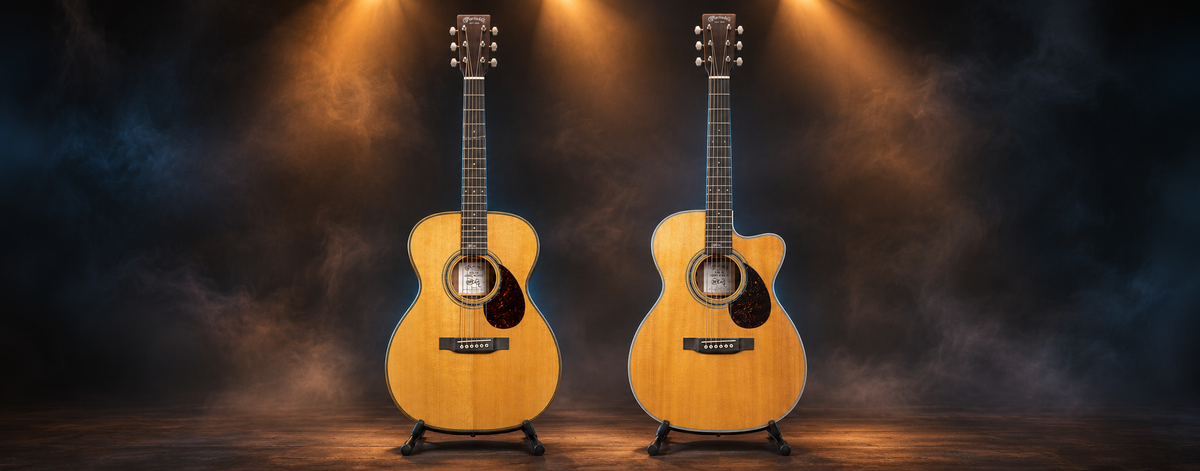
NEW MARTIN SIGNATURE ARTIST EDITIONS
Two new Martins. A little Mayer inspiration. A sound that’s yours.
Meet the Martin OM-13E John Mayer and Martin OMC-13E John Mayer : all-solid-wood Road Series electro-acoustics with Engelmann spruce tops, black walnut back and sides, and a choice of classic or cutaway body.
Some guitars make you want to put your phone down and pick a few notes instead. If you’ve ever disappeared down a John Mayer acoustic rabbit hole, you’ll know the feeling. The detail, the groove, the way a thumbed bass line and a melody seem to have their own conversation… suddenly, “just five minutes” becomes the rest of the evening.
Martin’s two new John Mayer models bring that inspiration into the Road Series for the first time. They’re official Signature Artist Editions, designed for players who want a versatile acoustic for their own songs, gigs and discoveries.
OM-13E or OMC-13E John Mayer: the quick answer
Choose the OM-13E John Mayer if you love the traditional non-cutaway outline and bold herringbone top detailing.
Choose the OMC-13E John Mayer if easier access to the higher frets matters to your playing.
Both share the same core tonewoods, neck specification, Martin E1 electronics and included softshell case. Both models are currently listed here at Fair Deal Music. Follow the product links for the latest price, availability and ordering information.


Why do Martin and John Mayer belong in the same conversation?
Martin has been building acoustic guitars since 1833, and its instruments have helped shape generations of songwriting, folk, blues and acoustic music. John Mayer’s partnership with the brand reaches back to the early 2000s, with the original OM-28JM followed by the enduring OMJM and later anniversary instruments.
It’s an association that makes musical sense. Mayer’s acoustic playing asks a guitar to handle detail and drive at the same time: independent bass notes, delicate melodic lines, percussive rhythms and full vocal accompaniment. A comfortable Orchestra Model format offers an appealing starting point for that kind of work.
The OM-13E John Mayer and OMC-13E John Mayer extend that partnership into a different part of Martin’s range. They pair artist-specific appointments with practical features for everyday playing, rehearsals and amplified performance. You don’t need to learn every note of Neon before you’re allowed to open the case.
What is Martin’s Road Series?
The Road Series brings Martin design and acoustic character together with features intended for regular use and performance. These two models combine all-solid tonewoods, built-in electronics and an included softshell case. Their place in the Road Series also distinguishes them from the higher-priced OMJM and Martin’s more exclusive signature instruments.
Martin OM-13E vs OMC-13E John Mayer: what’s different?
| Feature | OM-13E John Mayer | OMC-13E John Mayer |
|---|---|---|
| Body | 000 14-fret, non-cutaway OM format | 000 14-fret cutaway OM format |
| Main reason to choose it | Traditional outline and herringbone styling | Easier upper-fret access |
| Top | Solid Engelmann spruce, aging toner, gloss finish | |
| Back and sides | Solid black walnut, natural stain, gloss finish | |
| Top trim | Bold herringbone | Multi-stripe |
| Binding | Antique white | |
| Bracing | Scalloped spruce X-bracing | |
| Scale length | 25.4 inches | |
| Nut width | 1 11/16 inches, approximately 42.9 mm | |
| Neck | Performing Artist profile, standard taper, satin finish | |
| Fingerboard and bridge | Ebony; custom fingerboard inlay with John Mayer’s signature | |
| Electronics | Martin E1 | |
| Case | Martin softshell case included | |
The cutaway and top trim are the clearest buying distinctions. Choose the shape that suits your hands, playing habits and taste.
What should you expect from the sound and feel?
Engelmann spruce and black walnut: an interesting double act
Both guitars pair a solid Engelmann spruce soundboard with solid black walnut back and sides. Martin describes the intended character as balanced and responsive, combining warmth with clarity. For the player, that points towards a useful balance between expressive individual notes and full chord accompaniment.
Engelmann spruce is associated with sensitivity to a lighter touch, while the walnut gives these models a distinct alternative to the rosewood-backed OMJM. Tonewood descriptions are a starting point, though: your technique, strings, setup and the individual guitar all influence what you hear.
The scalloped X-bracing supports the top while allowing it to respond to the strings. Both models also have a gloss body finish and satin neck, combining traditional presentation with a smooth playing surface.
A compact body doesn’t mean a short-scale guitar
OM stands for Orchestra Model. Martin specifies the physical body size here as 000 14-fret, but both Mayer models have a 25.4-inch scale. The body outline alone doesn’t tell you how the strings will feel.
All else being equal, a longer scale carries more string tension than a shorter one at the same tuning and gauge. It can offer a firm, articulate response, while the 1 11/16-inch nut creates relatively close string spacing. Players moving from electric guitar may find that familiar; fingerstyle players who prefer more room should try the neck rather than assume every OM feels the same.
Which model suits playing further up the neck?
If your playing regularly takes you towards the higher frets, start with the Martin OMC-13E John Mayer . Its cutaway gives your fretting hand more room around the upper register, making it a practical choice for melodic lead lines and adventurous chord voicings.
If you mainly play accompaniment, fingerstyle patterns and open-position songs, the traditional outline of the Martin OM-13E John Mayer may be exactly what you’re looking for.
Are they good for John Mayer-style playing?
They’re a natural shortlist for players exploring thumb-led bass lines, melodic fingerpicking, percussive accompaniment and dynamic strumming. If Stop This Train, Who Says or Neon has sent you reaching for an acoustic, there’s plenty of inspiration here.
Those songs offer starting points for musical exploration. Your timing, muting, touch and practice shape the result. The good news? You can start with your own favourite chords.

Ready for the stage, useful in the studio
Both the OM-13E and OMC-13E include Martin E1 electronics, so you can connect to a suitable acoustic amplifier, PA system or audio interface. For recording, that gives you the option of a direct signal as well as the traditional microphone approach.
A microphone captures the acoustic sound in the room; the pickup offers a practical amplified route. Placement, EQ and the rest of your setup all influence the result. If you’re planning your first open-mic night or building a home-recording rig, we can help you put the pieces together.
What comes with the guitar?
A Martin softshell case is included with either model. Martin specifies Authentic Acoustic Lifespan 2.0 Light MA540T strings. Other shared details include an ebony bridge, white TUSQ saddle, white Corian nut, nickel open-gear tuners and 20 frets, with the neck joining the body at the 14th fret.
The custom fingerboard inlay includes John Mayer’s signature. The specification also lists a paper label with a pre-printed signature.
Your John Mayer Martin questions, answered
John Mayer, Joe Bonamassa or Eric Clapton: which Martin is right for me?
Start with feel and features, then let your favourite artist add the spark. The recent signature releases give you different approaches to the compact acoustic.
| Model | Key distinction | Put it on your shortlist if… |
|---|---|---|
| OM-13E John Mayer | Non-cutaway OM format; 25.4-inch scale; solid Engelmann spruce and black walnut; 1 11/16-inch nut | You want the Mayer-inspired feel, all-solid walnut construction and classic herringbone look. |
| OMC-13E John Mayer | The same core Mayer specification with a cutaway and multi-stripe top trim | You play lead lines or chord shapes higher up the neck and value easier access. |
| 00-10E Retro Joe Bonamassa | Smaller 00 body; 24.9-inch scale; solid spruce and sapele; 1 3/4-inch nut; visually worn-style sunburst | You prefer a compact blues-and-roots companion, a shorter scale and more space at the nut. |
| 000-13E Eric Clapton | Non-cutaway 000 body; spruce top; ziricote fine veneer back and sides; signature inlay and onboard pickup/tuner | You love the Clapton connection, traditional 000 outline and striking ziricote appearance. |
Our steer: choose Mayer for this particular long-scale, narrow-nut walnut specification; Bonamassa for the compact 00 and short-scale feel; Clapton for its own signature styling and 000 format. If upper-fret access is essential, the Mayer OMC is the clear cutaway choice among these models.
The Clapton 000-13E uses ziricote fine veneer back and sides. It is a separate model from the established 000-28EC and the more exclusive Custom Shop 000-42 Eric Clapton, so compare the specification of the exact guitar you’re considering.
The Clapton model also comes in 1935 Sunburst . Prefer a vintage look? Put that alongside the Joe Bonamassa 00-10E Retro before deciding.
Are the OM-13E and OMC-13E official John Mayer signature guitars?
Yes. Martin places both in its Signature Artist Editions, with the Road Series as their underlying series. They include custom John Mayer signature fingerboard inlays and artist-inspired specifications. You can view the individual details on the OM-13E product page and OMC-13E product page .
Are these the same as the Martin OMJM John Mayer?
No. The OMJM is a separate model. Its specification includes East Indian rosewood back and sides, a Low Profile neck and a simple dovetail neck joint. The new 13E models use black walnut back and sides, a Performing Artist neck and mortise-and-tenon construction. They share the familiar 25.4-inch scale and 1 11/16-inch nut, while offering their own construction and playing character.
Are both guitars all solid wood?
Yes. Both feature solid Engelmann spruce tops, solid black walnut backs and solid black walnut sides. This describes the main body tonewoods.
Are they limited editions or individually hand-signed?
Martin’s launch specification lists the edition size as open. The fingerboard signature is an inlay and the internal label carries a pre-printed signature. These are artist-specific design details rather than individual hand-signed autographs.
Where are they made?
These are Road Series models, the series Martin manufactures in Mexico. Speak to us if country of manufacture is an important part of your buying decision.
Will the cutaway make the OMC sound better or worse?
A cutaway changes the body geometry, while its main practical advantage is easier access to higher frets. Both models share their principal tonewoods and bracing specification. Choose by feel and the individual sound you prefer.
Compare the traditional OM-13E with the cutaway OMC-13E and consider where your fretting hand spends most of its time.
Can I strum them, or are they only for fingerstyle?
You can absolutely strum them. The specification makes them versatile choices for vocal accompaniment, songwriting, picking and acoustic pop or blues. If your priority is maximum unplugged volume under very heavy strumming, compare them with a dreadnought as well.
Are they suitable for beginners or electric guitarists moving to acoustic?
A committed beginner can learn on either, and the relatively narrow nut may appeal to electric players. Both are full-scale steel-string guitars. Try the neck, check the setup and choose the instrument that feels comfortable for you.
Is a left-handed version available?
Martin lists left-handed availability for both models. Contact the team for current ordering options, stock and lead times.
Do I need an amplifier to play an electro-acoustic guitar?
No. Both are fully functioning acoustic guitars and can be played unplugged. The built-in electronics give you the option of amplification when you need it.
Can I use alternative tunings?
Yes, suitable alternative tunings are part of normal acoustic playing. String gauge and setup affect tension and feel, especially for substantial tuning changes. Ask us for advice if you plan to keep the guitar in a particular tuning.
Does buying a signature guitar make me sound like John Mayer?
It gives you a relevant set of features and plenty of inspiration, but your touch, rhythm and technique shape the result. Use the artist connection as a starting point, then make the instrument your own. That’s where the fun really begins.
How should I care for an all-solid acoustic?
Keep it away from radiators, hot cars and sudden temperature changes, and follow Martin’s humidity and care advice. Store it in its case when appropriate, keep an eye on the environment and use suitable cleaning products. We can advise on care accessories when you choose your guitar.
Can I try one, order one or part-exchange my current guitar?
Check the OM-13E John Mayer and OMC-13E John Mayer product pages for current availability, then speak to our team to confirm showroom access or an expected delivery date.
We can also discuss part exchange and a trade-in valuation , alongside available finance options, subject to status. We’ll help you understand what’s possible before you commit.
Find your next Martin with Fair Deal Music
We’re an independent, family-run Birmingham music retailer, helping musicians since 1987. As we head towards our 40th anniversary in 2027, that still means the same thing: friendly advice from people who love music, and help choosing gear you’ll want to keep picking up.
Whether you’re comparing your first serious acoustic, adding something different to a collection or deciding which signature model feels right, we’re happy to talk it through. Ask us about current stock, trying an instrument in our Birmingham showroom, delivery arrangements and finance options, subject to status.
Buy. Sell. Trade. Find your next chapter.
Your current guitar could help fund the next one. We consider trade-ins and part exchanges on a wide range of instruments and equipment, so you can trade in, trade up and get back to the enjoyable bit: playing.
A little inspiration from John. A lot of possibilities for you.
Share:
Yamaha Genos2 Just Got Even Better: Free V2.00 Update & £250 Cashback