

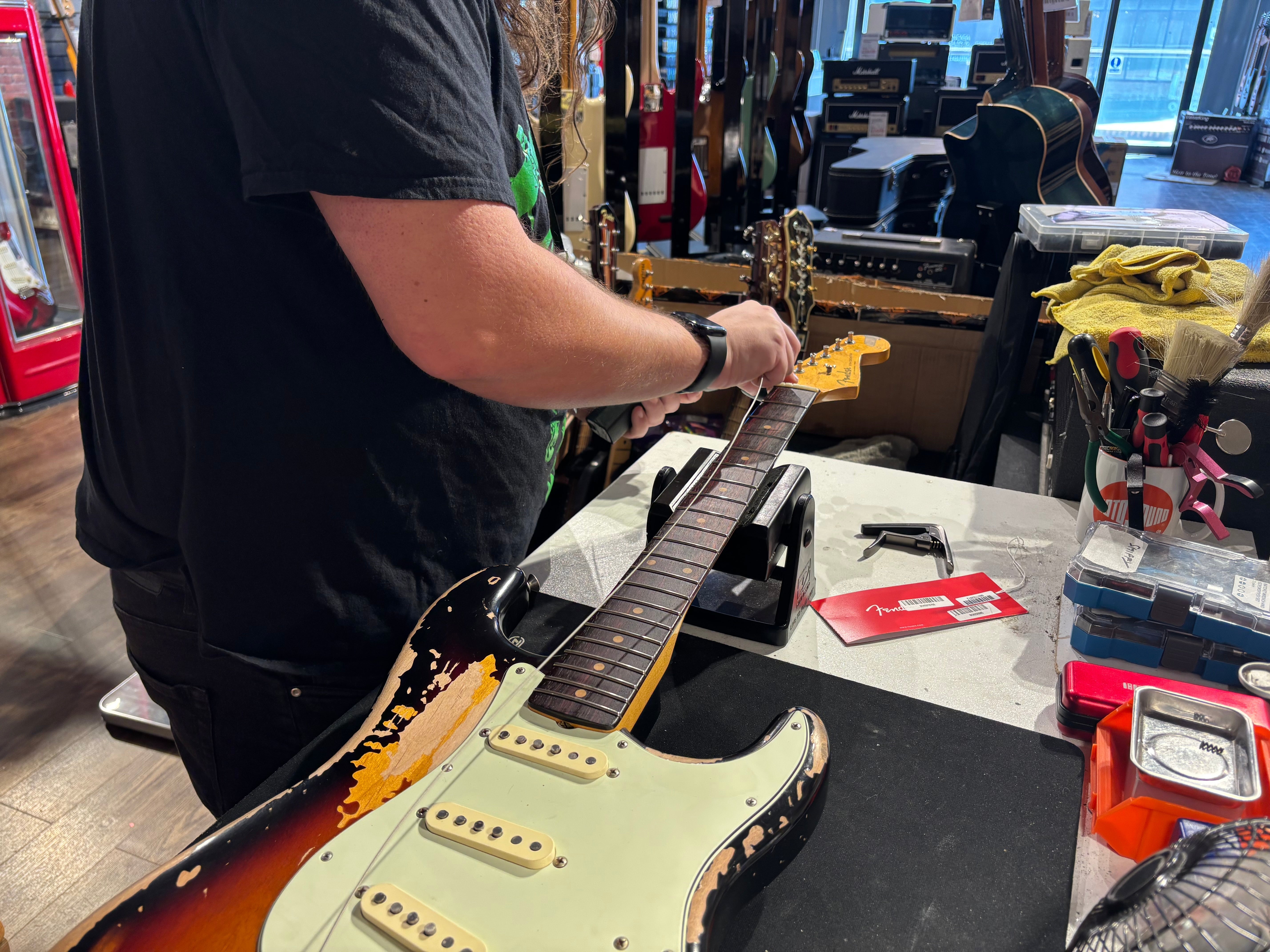
Have you ever had a buzzing sound when you play your guitar? Perhaps you have a loose jack hole and would like to have it fixed. Or maybe your guitar just needs a bit of TLC. Here at Fair Deal Music, we have a range of services to restore your instrument to its former glory so you can be rocking out in no time. The focus of today’s blog will be on all things strings.
Changing strings can be a daunting task if you are new to playing guitar. Some of you may even wonder why you need to change strings at all. Well, over time, strings will corrode and make your note sound flat and dull. Changing your strings will heavily impact your tone by adding brightness back (depending on the strings you choose) and help you stand out in a mix.
But how do you know the right strings to choose for you? Well, guitar strings come in different gauges and materials. The gauge is the diameter of the string measured in thousandths of an inch, so for instance, 10 - 42 gauge would be 0.0010” for the high E and 0.0042” for the low E. If you’re a beginner consider trying lighter strings to start with as it can make playing for long periods much easier on your hands.
Following on, how does the string material change the sound? In the same way, the gauges change the way the guitar plays, so too will the material. Electric guitar strings are most commonly made of either steel or nickel. Steel sounds sharper and brighter while nickel sounds warmer and more full-bodied.
Now, how to find the gauge for you. As mentioned previously, lighter gauges might suit a beginner player, as playing for longer periods - with a heavier gauge - can wear out your fingers quicker. Furthermore, different guitars will have different standard gauges. For example, the standard gauge for acoustic is 11-52, 10-46 for electric guitar, and 45-105. However, this isn’t a hard and fast rule. If you want to drop to a lower tuning, you may want to consider a lower gauge to make sure you maintain a good pitch when playing.
One more thing to mention today is the difference between flatwound and roundwound strings. Flatwound strings are great if you want to cause less damage to the fretboard, and so are good for guitars you routinely play on. Flatwound strings sound darker and mellow, with less sustain than their roundwound counterparts. Flatwounds are great for playing more jazz-based licks, and are more common on bass guitars and will last longer than roundwounds. Roundwounds are better suited to rock, pop, funk and more modern styles thanks to their brighter tone.
In the store, we often recommend D'Addario NYXL strings for electric guitar, due to their durability compared with other strings. This means you need to change your strings less and can enjoy your playing more.
For a bass guitar, we recommend the Rotosound flatwounds for the price and durability or if you prefer your roundwounds, the D'Addario XLs also do wonders.
Finally, for all you acoustic players, unsurprisingly, we've gone again with D'Addario's Phosphor Bronze as our recommendation.
If you have any queries about what sort of gauges you need for the sound you're trying to create, feel free to reach out and ask our team, and we can point you in the right direction.
Share:
Sounds Like Muse
Wham Bam Thank You Ma'am - A Look at Digitech Whammy Pedals