

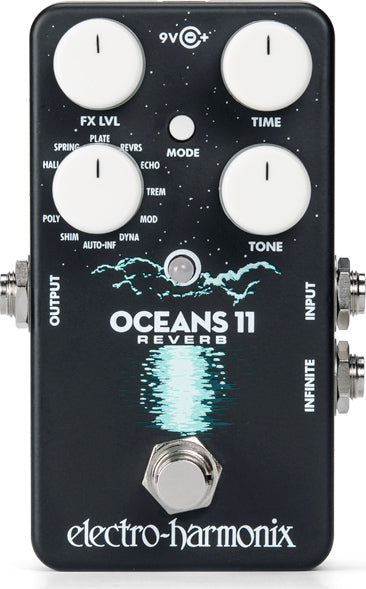
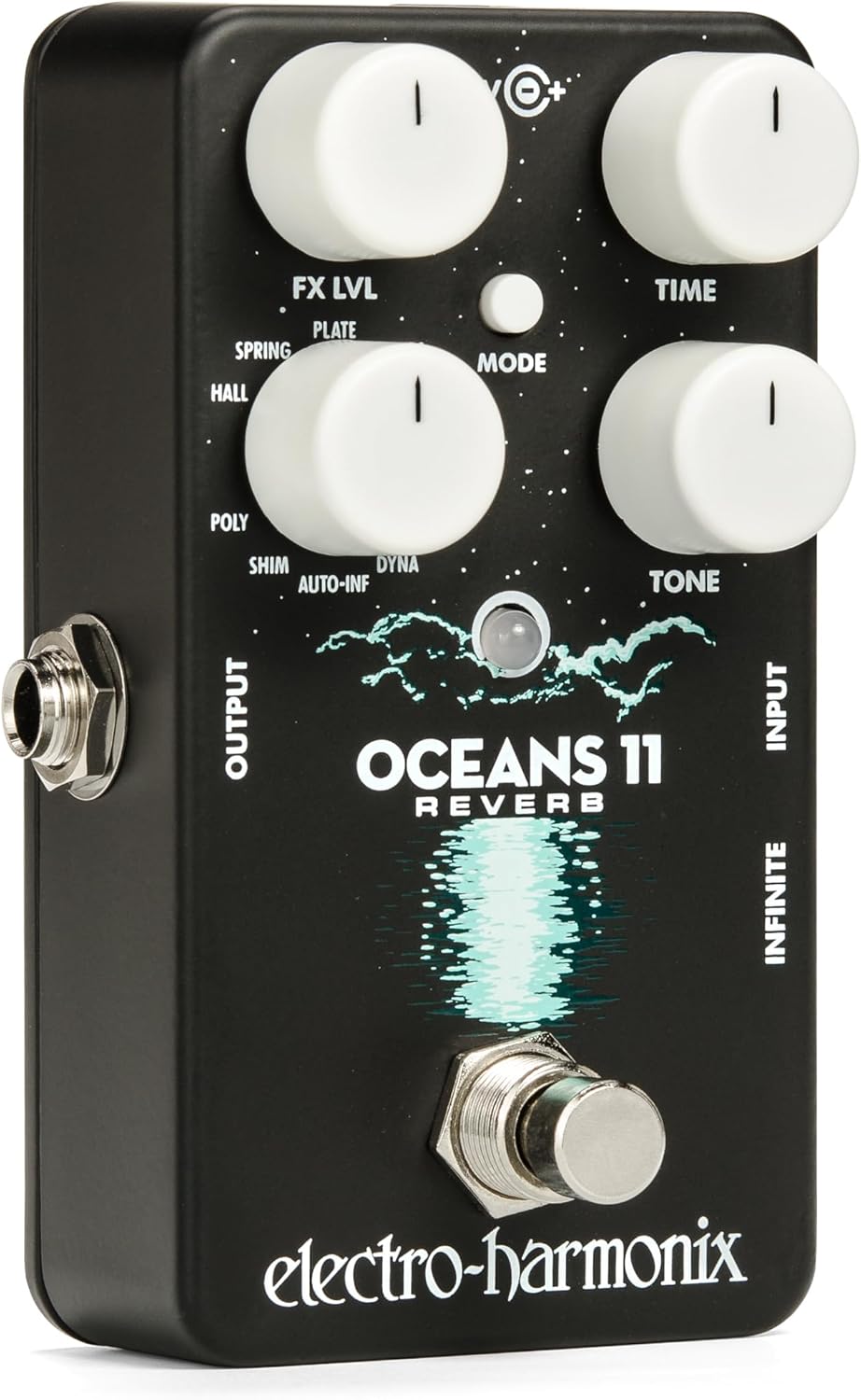
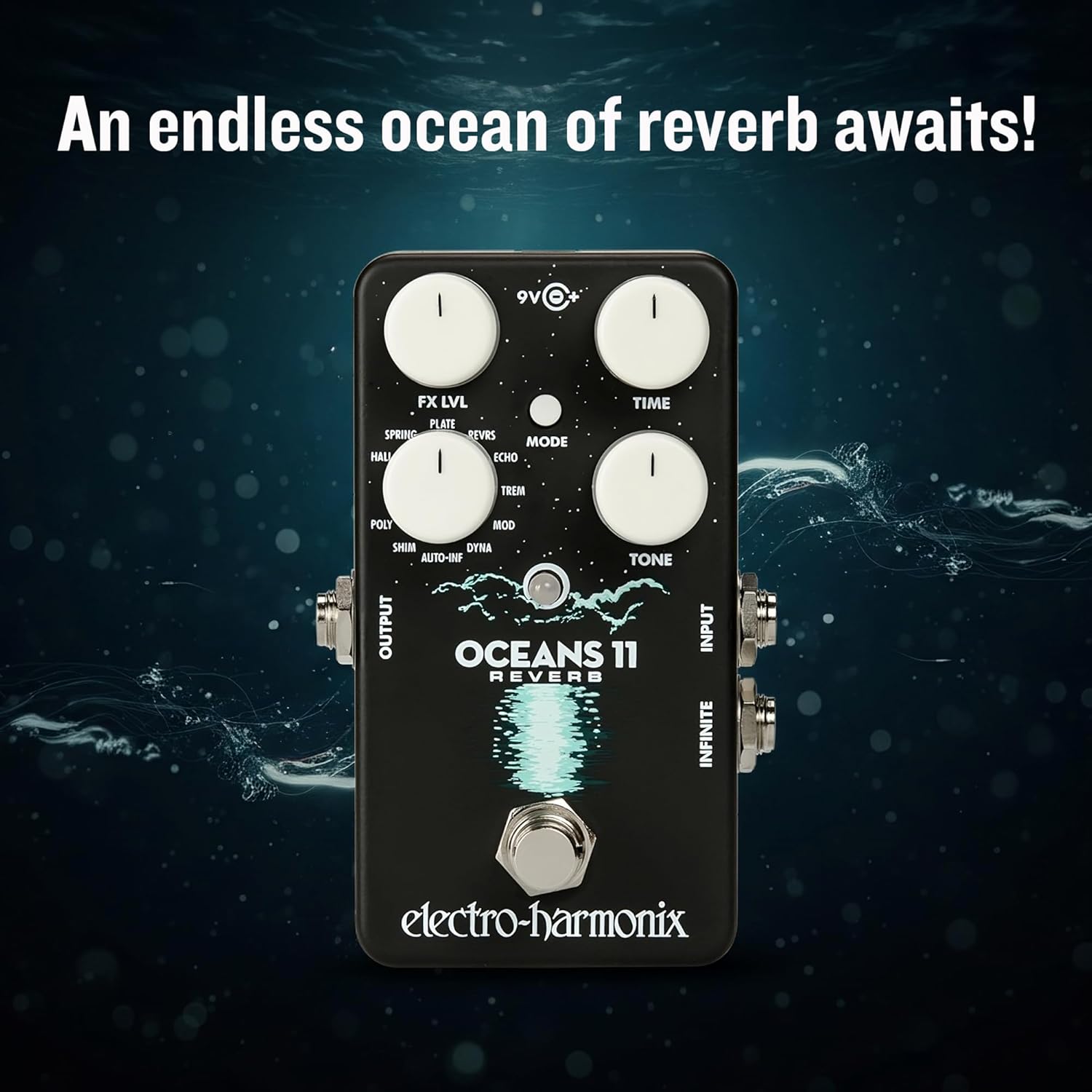
The Electro-Harmonix Oceans 11 is a compact multifunction reverb pedal offering 11 distinctive algorithms, ranging from essential Hall, Spring and Plate sounds to experimental shimmer, reverse, dynamic and polyphonic reverbs.
Its straightforward FX Level, Time and Tone controls provide fast access to the most important parameters, while the Mode button and Secondary Knob function reveal a much deeper level of editing. This makes the Oceans 11 equally suitable for players who want simple, dependable ambience and musicians who enjoy creating unusual, evolving soundscapes.
Infinite reverb, tap tempo for the Echo mode, optional reverb trails and external footswitch connectivity add serious performance flexibility. Supplied with its dedicated Electro-Harmonix power adapter, the Oceans 11 delivers an extensive collection of studio-inspired and creative reverb sounds in a compact pedalboard format.
Quick Product Summary
The Electro-Harmonix Oceans 11 is a digital multifunction reverb pedal with 11 selectable reverb types, multiple operating modes and additional hidden parameters.
It can produce traditional room-like ambience, vintage spring drip, smooth plate reverb, reverse effects, echo and tremolo combinations, modulated tails, dynamic gating, automatic infinite washes, octave shimmer and polyphonic pitch-shifted reverb.
The pedal is designed for guitarists, bassists, keyboard players and creative musicians who want a broad selection of reverb sounds without moving to a large multi-effects unit.
At A Glance
| Feature | Details |
|---|---|
| Brand | Electro-Harmonix |
| Model | Oceans 11 |
| Product Type | Multifunction digital reverb pedal |
| Reverb Types | 11 |
| Algorithms | Hall, Spring, Plate, Reverse, Echo, Tremolo, Modulated, Dynamic, Auto-Infinite, Shimmer and Polyphonic |
| Main Controls | FX Level, Time and Tone |
| Additional Control | Mode button with secondary parameter editing |
| Infinite Reverb | Available in most reverb types |
| Tap Tempo | Available in Echo mode |
| Reverb Trails | Internally switchable |
| External Control | Infinite and tap-tempo footswitch input |
| Bypass | Buffered bypass |
| Audio Format | Mono |
| Power | 9V DC, centre-negative |
| Current Draw | 150mA |
| Main Appeal | 11 detailed reverb algorithms in a compact enclosure |
| Best For | Live performance, recording, ambient effects and creative sound design |
| Condition | Brand New |
Why Choose the Electro-Harmonix Oceans 11?
Eleven Distinct Reverb Types
The Oceans 11 provides a broad selection of conventional and experimental reverb algorithms within one compact pedal.
The available types are:
-
Hall
-
Spring
-
Plate
-
Reverse
-
Echo
-
Tremolo
-
Modulated
-
Dynamic
-
Auto-Infinite
-
Shimmer
-
Polyphonic
This allows the pedal to cover subtle room-like space, vintage amplifier-inspired sounds, rhythmic effects and heavily transformed ambient textures.
Hall Reverb
The Hall setting produces a warm, spacious reverb inspired by the sound of a large performance venue.
Shorter decay settings can add natural depth without making the instrument feel distant. Increasing the Time control creates larger and more atmospheric spaces suitable for lead guitar, sustained chords and ambient playing.
Hall reverb works particularly well for:
-
General-purpose ambience
-
Clean guitar
-
Vocal-style lead tones
-
Piano and keyboard sounds
-
Slow melodic playing
-
Ambient chord progressions
Secondary controls provide access to pre-delay time and pre-delay feedback, allowing the start of the reverb to be separated from the original note.
Vintage-Inspired Spring Reverb
The Spring algorithm recreates the distinctive drip and bounce of a vintage 1962 Fender 6G15 outboard reverb unit.
Its lively attack and resonant decay make it ideal for:
-
Surf guitar
-
Rockabilly
-
Country
-
Blues
-
Vintage rock
-
Clean rhythm playing
-
Spaghetti-western textures
The Time control behaves like the dwell control on the original-style spring unit, changing how strongly the virtual spring system is driven.
Secondary controls allow different spring lengths to be selected and introduce adjustable preamp drive before the reverb.
With the pedal configured for reverb trails, a quick double tap of the footswitch can even simulate the crashing sound created by physically striking a spring-reverb tank.
Smooth Plate Reverb
Plate mode recreates the bright, smooth sound of the large metal reverb plates used in professional studios during the 1960s and 1970s.
Its polished response works particularly well with:
-
Lead guitar
-
Vocals
-
Snare-style percussion
-
Keyboards
-
Clean arpeggios
-
Sustained chords
-
Studio recording
The Plate algorithm adds density and shine without producing the obvious bounce of a spring reverb.
Reverse Reverb
Reverse mode recreates the studio technique of reversing a reverb recording so that the effect rises before the apparent source note.
The Time control adjusts the period between playing and hearing the reversed reverb fade in.
This mode is useful for:
-
Shoegaze
-
Ambient music
-
Experimental rock
-
Psychedelic textures
-
Swelling chord effects
-
Unusual lead sounds
-
Cinematic sound design
Placing the Oceans 11 before distortion or fuzz can transform the reverse effect into a dense and highly compressed wall of sound.
Echo Reverb
Echo combines digital delay with plate-style reverb.
The delay feeds into the reverb, allowing notes to repeat while each echo develops a smooth ambient tail. This can replace the need for separate basic delay and reverb pedals in a compact setup.
The built-in footswitch or a suitable external switch can be used to tap the required tempo. Three rhythmic subdivisions are available:
-
Eighth note
-
Quarter note
-
Dotted eighth note
The Time control adjusts echo time, while the Tone control adjusts the feedback level. Secondary parameters provide control over reverb decay and echo damping.
Tremolo Reverb
Trem mode combines Hall reverb with periodic volume modulation applied to both the dry and reverberated signals.
Three modulation shapes are available:
-
Triangle
-
Square
-
Sine
Triangle mode creates a smooth rise and fall. Square mode produces a more abrupt rhythmic pulse, while sine mode provides a rounded and flowing response.
The Time control adjusts modulation speed and the Tone control adjusts tremolo depth.
This mode is ideal for:
-
Vintage amplifier-style effects
-
Rhythmic chord patterns
-
Ambient pulses
-
Psychedelic guitar
-
Slow cinematic movement
-
Clean arpeggios
Modulated Reverb
Mod mode combines reverb with lush modulation for wide, animated decay tails.
Three variations are available:
-
Chorus
-
Flerb
-
Chorus and Flerb combined
The Chorus setting adds smooth pitch movement to the reverb tail, creating rich and spacious ambience.
Flerb combines flanging with reverb for a more pronounced Electro-Harmonix-style sweep.
The combined mode blends both modulation types, allowing the balance between Chorus and Flerb to be adjusted.
Dynamic Reverb
Dynamic mode contains three algorithms that respond to the way the instrument is played.
Swell
Swell suppresses the initial attack and gradually fades in the reverb tail. It is ideal for creating smooth, pad-like textures without using a volume pedal.
Gate
Gate allows reverb through only when the input signal is strong enough to cross the selected threshold. It can produce short, controlled and highly rhythmic reverb effects.
Duck
Duck lowers the reverb level while notes are being played, then allows the effect to become more prominent as the dry signal fades.
This keeps fast playing clear while still providing a large ambient tail between phrases.
Auto-Infinite Reverb
Auto-Infinite listens to the performance and creates a new sustained wash whenever it detects a newly played note or chord.
Instead of simply layering every note into one increasingly dense sound, it crossfades between reverb washes. This creates a continuously evolving background that responds to the player.
It is particularly effective for:
-
Ambient improvisation
-
Drone textures
-
Soundtrack work
-
Slow chord changes
-
Solo performance
-
Experimental sound design
Shimmer Reverb
Shimmer adds octave-shifted harmonies to the reverb tail, creating a bright and expansive cloud behind the original signal.
It can produce:
-
Ethereal upper-octave ambience
-
Choir-like textures
-
Cinematic soundscapes
-
Sustained harmonic washes
-
Wide ambient guitar
-
Synth-inspired effects
The Tone control affects both the frequency balance of the reverb and the octave-shifted content.
Secondary controls adjust modulation speed and depth, allowing the shimmer tail to move from relatively smooth to noticeably animated.
Polyphonic Reverb
Poly mode applies two independently configurable pitch shifts before the signal enters the reverb.
Each shifted voice can be set in semitone steps from one octave below to one octave above the original pitch.
This can create:
-
Upper and lower octave layers
-
Perfect-fifth harmonies
-
Dissonant pitch clusters
-
Multi-voice ambient chords
-
Organ-inspired textures
-
Cinematic drones
-
Experimental soundscapes
A second editing mode adjusts the balance between the dry and shifted voices, as well as the balance between the two pitch-shifted signals.
Because the processing is polyphonic, the effect can respond to chords as well as individual notes.
Powerful Secondary Knob Mode
Each reverb type includes additional parameters that can be accessed by holding the Mode button.
These secondary functions provide deeper control over features such as:
-
Pre-delay
-
Pre-delay feedback
-
Spring length
-
Preamp drive
-
Modulation speed
-
Modulation depth
-
Gate threshold
-
Swell timing
-
Duck response
-
Auto-Infinite sensitivity
-
Pitch-shift intervals
-
Shifted-signal balance
-
Reverb decay within combined effects
Secondary settings are stored independently for each reverb type and remain available after the pedal has been disconnected from power.
Infinite Reverb
Most of the Oceans 11 algorithms support an Infinite function.
Holding the footswitch captures and sustains the current reverb indefinitely. The player can then continue performing through a fresh, independently controlled reverb while the frozen wash remains underneath.
This can be used to create:
-
Sustained drones
-
Chordal backing layers
-
Ambient transitions
-
Continuous textures between songs
-
Improvised soundscapes
-
Organ-style foundations
Infinite reverb can be controlled from the pedal’s built-in footswitch or from a compatible external momentary switch.
Optional External Footswitch Control
The dedicated Infinite jack accepts a normally open momentary footswitch.
Depending on the selected algorithm, the external switch can control:
-
Infinite reverb
-
Echo tap tempo
-
Spring-tank kick effect
Using an external switch allows these performance functions to remain accessible without holding or repeatedly tapping the pedal’s main bypass footswitch.
Switchable Reverb Trails
An internal Tails switch determines what happens to the current reverb when the pedal is bypassed.
With Tails switched on, the existing reverb fades naturally after bypass while newly played notes remain dry.
With Tails switched off, the reverb stops immediately when the pedal is bypassed.
This allows the Oceans 11 to suit both smooth ambient transitions and precise, abrupt effect changes.
Wet-Only Operation
The FX Level control adjusts the balance between the original and reverberated signals.
At minimum, the output is fully dry. Increasing the control raises the reverb level, while settings beyond approximately two o’clock begin reducing the dry signal.
At maximum, the pedal produces a completely wet reverb output. This is useful for parallel processing, studio effects loops and highly transformed ambient sounds.
Compact Pedalboard Format
Despite offering 11 algorithms and extensive editing functions, the Oceans 11 fits into a compact Electro-Harmonix enclosure.
It provides a substantial range of creative reverb effects without occupying the space required by a large workstation or multi-effects processor.
Why Choose a Multifunction Reverb Pedal?
A multifunction reverb pedal provides several different ways of placing an instrument within a virtual acoustic space.
Traditional reverbs such as Hall, Spring and Plate recreate familiar rooms and studio devices. More experimental types use modulation, pitch shifting, delay, gating and reverse processing to turn reverb into a creative effect.
A versatile reverb pedal can be used to:
-
Add natural depth to a dry amplifier
-
Create vintage spring-reverb sounds
-
Add polish to lead guitar
-
Produce rhythmic echoes
-
Generate ambient pads
-
Smooth the attack of notes
-
Build infinite backing layers
-
Create octave-shifted shimmer
-
Transform chords with reverse ambience
-
Add motion through modulation or tremolo
-
Develop experimental cinematic textures
The Oceans 11 combines these possibilities in a format that remains practical for everyday pedalboard use.
Who Is the Electro-Harmonix Oceans 11 For?
Guitarists Building a Versatile Pedalboard
The 11 algorithms cover traditional, modern and experimental sounds, reducing the need to carry several separate reverb pedals.
Ambient and Post-Rock Players
Infinite sustain, shimmer, reverse, modulation and Auto-Infinite modes provide the tools needed to create wide, evolving soundscapes.
Surf and Vintage-Rock Guitarists
The Spring algorithm provides the characteristic drip and bounce associated with vintage outboard spring-reverb units.
Singer-Songwriters
Hall and Plate settings can add depth and polish without overwhelming vocals or acoustic arrangements.
Shoegaze Musicians
Reverse, Shimmer and Modulated modes work particularly well when combined with fuzz, distortion, delay and chorus.
Worship Guitarists
Long Hall, Shimmer, Duck and Modulated reverbs can create spacious textures while retaining clarity during chord changes.
Keyboard and Synthesiser Players
The Oceans 11 can add room-like depth, pitch-shifted ambience and evolving modulation to compatible mono keyboard and synthesiser signals.
Recording Musicians
Wet-only operation and adjustable secondary parameters make the pedal useful for tracking, re-amping and hardware effects processing.
Experimental Sound Designers
Polyphonic pitch shifting, dynamic algorithms, Auto-Infinite and hidden editing functions provide substantial scope for unusual effects.
What’s Included?
-
Electro-Harmonix Oceans 11 multifunction digital reverb pedal
-
Electro-Harmonix EHX9.6DC 200mA power adapter
External momentary footswitch not included.
Fair Deal Quality Control Assessment
Every effects pedal supplied by Fair Deal Music is checked by our experienced team before dispatch.
Our assessment includes:
-
Enclosure and control inspection
-
Input and output socket test
-
Infinite footswitch input check
-
FX Level, Time and Tone control test
-
All 11 reverb algorithms checked
-
Mode button and alternate modes tested
-
Secondary Knob functions assessed
-
Infinite reverb operation
-
Echo tap-tempo function
-
Buffered-bypass operation
-
Footswitch and status LED check
-
Power input and adapter inspection
-
Final presentation and packing assessment
Technical Specifications
General
| Specification | Details |
|---|---|
| Effect Type | Multifunction digital reverb |
| Processing | Digital |
| Number of Reverb Types | 11 |
| Audio Format | Mono |
| Bypass Type | Buffered bypass |
| Reverb Trails | Internally switchable |
| Infinite Function | Available in most algorithms |
| Tap Tempo | Echo mode |
| Year Introduced | 2018 |
| Dimensions | 4.5 × 2.75 × 2.1 inches |
| UPC | 683274012100 |
Reverb Algorithms
| Reverb Type | Description |
|---|---|
| Hall | Warm, spacious performance-hall ambience |
| Spring | Vintage-inspired spring reverb with drip and tank-kick effect |
| Plate | Smooth and bright studio plate simulation |
| Reverse | Reverb that fades in after each note |
| Echo | Digital delay feeding into plate reverb |
| Tremolo | Hall reverb combined with rhythmic volume modulation |
| Modulated | Reverb with Chorus, Flerb or combined modulation |
| Dynamic | Swell, Gate and Duck reverb algorithms |
| Auto-Infinite | Automatically crossfades between sustained reverb washes |
| Shimmer | Octave-shifted reverb with modulation |
| Polyphonic | Reverb with two configurable bidirectional pitch shifts |
Main Controls
| Control | Function |
|---|---|
| FX Level | Adjusts the balance between dry and reverberated signals |
| Time | Normally adjusts reverb decay or the principal timing parameter |
| Tone | Normally adjusts reverb brightness or an algorithm-specific parameter |
| Reverb Type | Selects one of the 11 reverb algorithms |
| Mode Button | Selects algorithm variations and accesses secondary controls |
| Footswitch | Selects effect or bypass and controls additional performance functions |
| Status LED | Displays effect status, selected mode, tempo and Infinite status |
Available Algorithm Modes
| Algorithm | Modes |
|---|---|
| Hall | One mode |
| Spring | One mode |
| Plate | One mode |
| Reverse | One mode |
| Echo | Eighth note, quarter note and dotted eighth note |
| Tremolo | Triangle, square and sine waveforms |
| Modulated | Chorus, Flerb and Chorus/Flerb combination |
| Dynamic | Swell, Gate and Duck |
| Auto-Infinite | One mode |
| Shimmer | One mode |
| Polyphonic | Interval editing and mix editing |
Connections
| Connection | Details |
|---|---|
| Input | ¼-inch mono jack |
| Input Impedance | 1MΩ |
| Output | ¼-inch mono jack |
| Output Impedance | 680Ω |
| Infinite Input | ¼-inch normally open momentary footswitch connection |
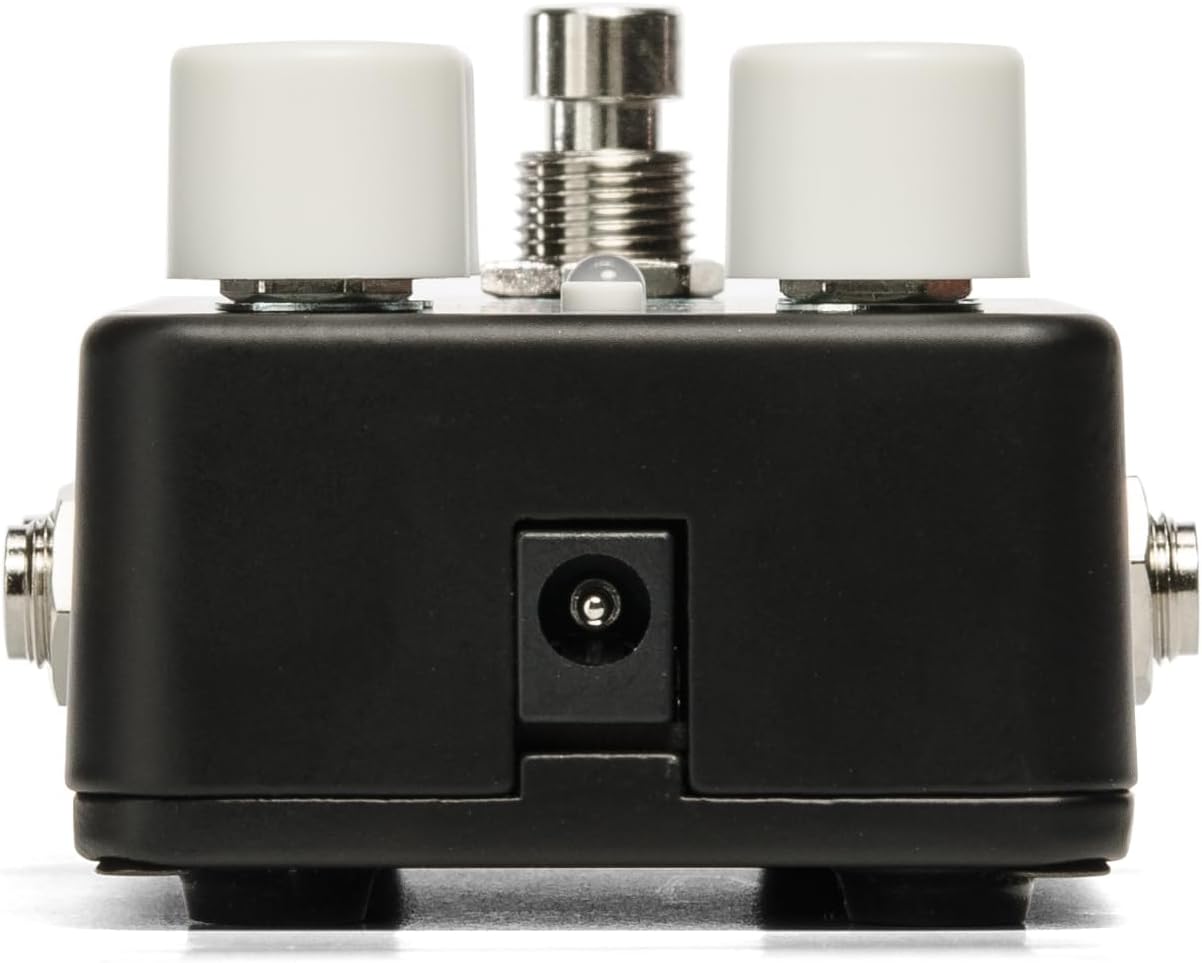
| Power Input | Centre-negative DC barrel connection |
Power Requirements
The Electro-Harmonix Oceans 11 requires regulated 9V DC power with centre-negative polarity.
| Specification | Details |
|---|---|
| Operating Voltage | 9V DC |
| Current Draw | 150mA |
| Polarity | Centre-negative |
| Battery Operation | No |
A pedalboard power supply must provide at least 150mA from an isolated or suitably regulated 9V output. A lower-current output can cause unreliable operation, unwanted noise or failure to start correctly.
Where Should the Oceans 11 Be Placed?
In an Amplifier Effects Loop
Placing the Oceans 11 in an effects loop keeps the reverb after the amplifier’s preamp distortion. This normally produces clearer and more defined reverb when using high-gain amplifier sounds.
After Overdrive and Distortion
This conventional pedalboard position allows the reverb to process the completed driven tone, creating clear tails and natural ambience.
Before Overdrive or Fuzz
Placing reverb before gain compresses and distorts the reverb tail. This can create dense, dramatic textures suited to shoegaze, ambient and experimental music.
After Delay
A conventional arrangement places reverb after delay so that the echoes appear within the same virtual space.
Before Delay
Placing reverb first causes the delay to repeat the complete reverberated sound, producing more layered and unusual textures.
Electro-Harmonix Oceans 11 Compared with Other Reverb Pedals
Oceans 11 vs Electro-Harmonix Pico Oceans 3-Verb
The Pico Oceans 3-Verb concentrates on Hall, Spring and Plate sounds in an exceptionally small enclosure.
The Oceans 11 adds eight further algorithms, multiple modes, secondary controls, Infinite reverb, an external footswitch input and more extensive performance functions.
Choose the Pico Oceans 3-Verb for compact access to essential reverb types. Choose the Oceans 11 for broader creative range and deeper editing.
Oceans 11 vs Electro-Harmonix Oceans 12
The Oceans 12 provides two independent stereo reverb engines, preset storage, expression control, series or parallel routing and more extensive connectivity.
The Oceans 11 is smaller, more immediate and easier to accommodate on a conventional mono pedalboard.
Choose the Oceans 11 for compact versatility. Choose the Oceans 12 for dual-engine stereo processing and programmable live setups.
Oceans 11 vs Electro-Harmonix Holy Grail Neo
The Holy Grail Neo focuses on a smaller collection of straightforward reverb sounds with a simplified control layout.
The Oceans 11 provides a much wider selection of algorithms and considerably deeper editing.
Choose the Holy Grail Neo for maximum simplicity. Choose the Oceans 11 for traditional ambience and experimental effects within one pedal.
Oceans 11 vs Separate Reverb and Delay Pedals
The Echo algorithm combines digital delay and plate reverb in one setting, making it useful for compact setups.
Dedicated reverb and delay pedals provide more independent control and allow both effects to be switched separately. The Oceans 11 offers a convenient all-in-one solution when pedalboard space is limited.
Oceans 11 vs Large Multi-Effects Reverb Units
Larger reverb processors may offer stereo operation, presets, MIDI control and detailed display-based editing.
The Oceans 11 focuses on direct controls, compact dimensions and fast access to a wide selection of sounds without extensive menu navigation.
Frequently Asked Questions
Is the Electro-Harmonix Oceans 11 stereo?
No. It has one mono input and one mono output.
Players requiring stereo connectivity should consider a stereo reverb system such as the Electro-Harmonix Oceans 12.
Does the Oceans 11 store presets?
It does not provide conventional named preset locations.
The pedal remembers the most recently selected mode and secondary parameter settings for each reverb type, including after it has been disconnected from power.
Can the reverb continue after the pedal is bypassed?
Yes. An internal Tails switch determines whether the current reverb fades naturally or stops immediately when the effect is bypassed.
Can the Oceans 11 produce a completely wet signal?
Yes. Turning FX Level fully clockwise removes the dry signal and produces a wet-only output.
Can an external footswitch be connected?
Yes. A compatible normally open momentary footswitch can control Infinite reverb, Echo tap tempo and the Spring tank-kick function.
Can the Oceans 11 create infinite sustain?
Most of its algorithms support Infinite reverb. Holding the appropriate footswitch sustains the current reverb wash while allowing new notes to be played through a fresh effect.
Does the Echo mode include tap tempo?
Yes. Tempo can be entered through the built-in footswitch or an optional external momentary switch.
Is the Oceans 11 suitable for bass guitar?
Yes. Shorter, darker reverbs can add depth without overwhelming the low frequencies, while the experimental algorithms can create synth-like and ambient bass textures.
Can it be used with keyboards?
Yes. Compatible mono keyboard and synthesiser outputs can be processed through the pedal. The source level should be adjusted carefully to avoid overloading the input.
Can the Oceans 11 run from a battery?
No. It requires a suitable external 9V DC power source capable of providing at least 150mA.
Does it have a spring-reverb tank inside?
No. The Spring setting digitally recreates the behaviour and character of a vintage mechanical spring-reverb system.
Can the hidden parameters be reset?
Yes. The secondary settings for an individual algorithm or every algorithm can be restored to their factory defaults using the pedal’s control combinations.
Fair Deal Music Verdict
★★★★★ 5/5
The Electro-Harmonix Oceans 11 is an exceptionally versatile reverb pedal that manages to combine extensive creative depth with a compact and approachable control layout.
Its Hall, Spring and Plate settings cover essential everyday sounds, while Reverse, Modulated, Dynamic, Auto-Infinite, Shimmer and Polyphonic modes provide a huge amount of creative scope. Infinite sustain, tap tempo, wet-only operation and secondary editing make it capable enough for sophisticated live and recording setups without turning it into a menu-heavy workstation.
For guitarists, bassists, keyboard players and sound designers seeking one compact pedal that can provide both dependable ambience and genuinely unusual effects, the Oceans 11 is an outstanding choice.
Why Buy From Fair Deal Music?
Choosing Fair Deal Music means buying from a passionate team of musicians who genuinely understand the products we sell. Whether you're purchasing your first instrument, upgrading your current setup or searching for something special, we're here to help you make the right choice with friendly advice and expert support.
When you shop with Fair Deal Music, you can buy with confidence thanks to:
-
Expert advice from knowledgeable musicians
-
Carefully checked new, used, pre-owned and ex-display equipment
-
Competitive prices on leading music brands
-
Secure UK-wide delivery
-
Flexible finance options available, subject to status
-
Friendly support before and after your purchase
-
A trusted independent UK music retailer with decades of experience
Trade In. Trade Up. Save More.
Thinking about upgrading? Your next piece of gear could cost less than you think.
We're always happy to consider part exchanges and trade-ins on a wide range of musical instruments and equipment. Whether you're looking to move on a guitar, amplifier, keyboard, drum kit, studio equipment or another piece of gear, our team can provide a straightforward, no-obligation valuation.
Simply get in touch with details and photographs of your equipment, and we'll help you explore your options. It's an easy way to unlock the value of your current gear and put it towards something new.