

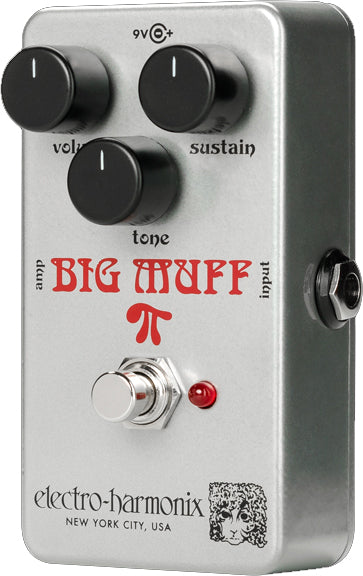
Electro Harmonix Ram's Head Big Muff Fuzz Pedal
Pairs well with
Electro Harmonix Ram's Head Big Muff Fuzz Pedal
Description
The Electro-Harmonix Ram’s Head Big Muff Pi faithfully recreates the highly sought-after 1973 Violet Ram’s Head V2 circuit in a compact, pedalboard-friendly enclosure. It delivers the rich harmonic saturation and exceptional sustain associated with the Big Muff family while retaining impressive string separation, note definition and midrange presence.
Compared with darker or more heavily scooped Big Muff variations, the Ram’s Head has a clear, articulate response that allows individual notes to remain audible within large chords and heavily layered guitar parts. It can move from warm, rounded rhythm fuzz to bright, singing lead tones using the familiar Volume, Tone and Sustain controls.
Modern additions include true-bypass switching, an effect-status LED and compatibility with a standard 9V centre-negative power supply. Vintage-inspired graphics and a compact Nano-sized enclosure complete a practical recreation of one of Electro-Harmonix’s most desirable historic fuzz circuits.
Quick Product Summary
The Electro-Harmonix Ram’s Head Big Muff Pi is an analogue fuzz, distortion and sustainer pedal based on the Violet Ram’s Head V2 Big Muff introduced in 1973.
Its smooth sustain, defined attack and articulate chord response make it an excellent choice for soaring lead guitar, heavy rhythm parts, alternative rock, psychedelic textures and expansive ambient sounds.
Three straightforward controls provide a wide tonal range without menus or secondary functions, while true bypass and compact dimensions make the pedal easy to integrate into almost any guitar setup.
At A Glance
| Feature | Details |
|---|---|
| Brand | Electro-Harmonix |
| Model | Ram’s Head Big Muff Pi |
| Product Type | Fuzz, distortion and sustainer pedal |
| Circuit | Analogue |
| Inspiration | 1973 Violet Ram’s Head V2 Big Muff Pi |
| Controls | Volume, Tone and Sustain |
| Bypass | True bypass |
| Audio Format | Mono |
| Input | ¼-inch mono jack |
| Output | ¼-inch mono jack |
| Power | 9V battery or optional 9V DC adapter |
| Current Draw | 2mA |
| Dimensions | 4.5 × 2.75 × 2.1 inches |
| Original Version Released | 1973 |
| Compact Reissue Released | 2019 |
| Main Appeal | Articulate vintage-style Big Muff tone with exceptional sustain |
| Best For | Rock, alternative, psychedelic, shoegaze, ambient and lead guitar |
| Suitable Instruments | Electric guitar, bass and compatible electronic instruments |
| Condition | Brand New |
Why Choose the Electro-Harmonix Ram’s Head Big Muff Pi?
Faithful Violet Ram’s Head V2 Recreation
The pedal is based on the highly coveted Violet Ram’s Head Big Muff Pi circuit produced during the early 1970s.
This version of the Big Muff became known for combining thick distortion and long sustain with greater string separation than many other Muff circuits. The compact reissue captures that distinctive character while adding features suited to a modern pedalboard.
It offers:
-
Rich analogue saturation
-
Clearer chord definition
-
Smooth, extended sustain
-
Strong harmonic content
-
Responsive tone shaping
-
Vintage-inspired graphics
-
Modern true-bypass switching
Exceptional String Separation
High-gain fuzz can sometimes cause complex chords to collapse into an indistinct wall of sound. The Ram’s Head Big Muff Pi retains more definition between individual notes, allowing chord voicings and melodic movement to remain recognisable.
This makes it particularly effective for:
-
Open chord voicings
-
Arpeggiated passages
-
Layered rhythm guitar
-
Double-stopped lead lines
-
Extended and suspended chords
-
Fuzz-heavy ambient arrangements
-
Complex riffs played through high gain
The result remains unmistakably thick and saturated while preserving more of the original performance.
Long, Singing Sustain
The Ram’s Head circuit produces the smooth and compressed sustain for which the Big Muff is famous.
Single notes can develop into long, violin-like lead tones, particularly when the Sustain control is increased and the pedal is paired with an amplifier near the edge of breakup.
This sustained response is ideal for:
-
Melodic lead guitar
-
Slow bends
-
Controlled feedback
-
Sustained chord textures
-
Slide guitar
-
Ambient volume swells
-
Expressive vibrato
-
Psychedelic soloing
Wide-Ranging Tone Control
The Tone control adjusts the balance between bass and treble.
Turning it anticlockwise increases the low-frequency content and reduces the treble, producing a deeper and warmer sound. Turning it clockwise increases treble while reducing bass, creating a brighter and more cutting response.
This allows the pedal to adapt to:
-
Bright single-coil pickups
-
Darker humbuckers
-
Clean or driven amplifiers
-
Standard and lower tunings
-
Rhythm and lead guitar
-
Dense or sparse arrangements
The central settings provide the recognisable balanced Ram’s Head voice, while the extremes offer significantly darker or sharper variations.
Powerful Sustain Control
The Sustain control determines the intensity of the distortion, compression and note sustain.
Lower settings provide a more open and responsive fuzz sound with additional pick definition. Increasing the control produces heavier saturation, greater compression and longer sustain.
Lower settings work well for:
-
Vintage rhythm fuzz
-
Dynamic chord playing
-
Garage-rock textures
-
Overdrive-like distortion
-
Stacked gain sounds
Higher settings are ideal for:
-
Heavy rhythm guitar
-
Singing lead tones
-
Shoegaze soundscapes
-
Psychedelic solos
-
Sustained feedback
-
Dense ambient layers
Adjustable Output Volume
The Volume control sets the overall output level of the pedal.
It can be used to match the level of the bypassed guitar signal, compensate for different Tone and Sustain settings or push the front end of an amplifier and subsequent pedals.
Increasing the output can add further intensity when the Ram’s Head is used with a valve amplifier or another gain stage.
Articulate Midrange Character
The Ram’s Head offers a defined and present voice that helps it remain audible within a full band arrangement.
Its combination of harmonic richness and articulation works particularly well when competing with:
-
Distorted rhythm guitars
-
Keyboards and synthesisers
-
Layered backing tracks
-
Heavy drums
-
Additional fuzz or modulation
-
Dense studio production
This makes the pedal especially effective for lead guitarists who want classic Big Muff sustain without losing the shape of each note.
Works Well with Other Effects
The Ram’s Head Big Muff Pi responds effectively when combined with modulation, delay, reverb, octave and additional gain pedals.
Popular combinations include:
-
Overdrive before the Ram’s Head for added midrange focus
-
Chorus after the fuzz for wide alternative-rock textures
-
Phaser before the fuzz for integrated psychedelic movement
-
Delay after the fuzz for sustained lead repeats
-
Reverb after the fuzz for expansive ambient sound
-
Octave effects before the fuzz for synth-like saturation
-
Equalisation after the fuzz for precise frequency shaping
Its articulate core sound gives other effects a strong and harmonically rich foundation.
True-Bypass Switching
The Ram’s Head Big Muff Pi uses true-bypass switching.
When the effect is bypassed, the input is connected directly to the output, removing the active fuzz circuit from the signal path.
An LED clearly indicates when the effect is active.
Compact Pedalboard-Friendly Enclosure
The original 1970s pedals used a significantly larger enclosure. This reissue places the essential Ram’s Head circuit into a compact chassis measuring 4.5 × 2.75 × 2.1 inches.
The smaller footprint leaves more room for additional effects while retaining a clear three-knob layout and vintage-inspired appearance.
Extremely Low Current Draw
The pedal draws approximately 2mA, placing very little demand on a compatible pedalboard power supply.
Its low power consumption also makes battery operation practical for players using a simple setup without a mains-powered pedalboard.
Why Choose an Analogue Fuzz and Sustainer Pedal?
An analogue fuzz pedal transforms the instrument signal through clipping and saturation, generating additional harmonics and compression.
The Big Muff design sits between traditional fuzz and distortion. It can produce the broad harmonic texture of fuzz alongside the smooth sustain and consistency associated with high-gain distortion.
A fuzz and sustainer pedal can be used to:
-
Extend the sustain of lead notes
-
Add weight to power chords
-
Create thick rhythm guitar layers
-
Produce controlled feedback
-
Transform clean sounds into aggressive textures
-
Add harmonic complexity before modulation
-
Build ambient walls of sound
-
Create synthesiser-like guitar tones
-
Reinforce bass riffs
-
Produce vintage psychedelic sounds
The Ram’s Head variation is especially useful for players who need these qualities while retaining greater definition and string separation.
Who Is the Electro-Harmonix Ram’s Head Big Muff Pi For?
Lead Guitarists
Its long sustain and articulate upper-mid response make it ideal for expressive bends, melodic solos and smooth, vocal-like lead tones.
Alternative and Indie Musicians
The pedal can produce defined rhythm fuzz, saturated chord layers and cutting lead sounds suited to alternative and independent guitar music.
Psychedelic Players
High Sustain settings create broad harmonic textures, controlled feedback and fluid lead tones that work naturally with delay, phaser and reverb.
Shoegaze Guitarists
The articulate response helps chords retain some internal definition when the pedal is combined with heavy reverb, delay and modulation.
Classic Rock Players
The vintage-inspired analogue circuit works particularly well with valve amplifiers, single-coil pickups and traditional lead-guitar techniques.
Ambient Musicians
Long sustain allows notes and chords to flow smoothly into delay and reverb, creating expansive soundscapes and evolving textures.
Bassists
The Ram’s Head can create powerful sustained bass fuzz with a defined attack. Bassists requiring a separate clean blend may prefer to combine it with a parallel effects system or dedicated bass blender.
Recording Musicians
Its recognisable yet articulate character makes it useful for layering rhythm parts, adding sustained lead lines and creating contrasting fuzz textures within a mix.
Existing Big Muff Users
Players who enjoy the thickness of a Big Muff but want greater clarity, string separation and vintage V2 character will find the Ram’s Head especially appealing.
What’s Included?
-
Electro-Harmonix Ram’s Head Big Muff Pi pedal
-
9V battery
External power adapter not included.
Fair Deal Quality Control Assessment
Every effects pedal supplied by Fair Deal Music is checked by our experienced team before dispatch.
Our assessment includes:
-
Enclosure and control inspection
-
Input socket test
-
Output socket test
-
Volume-control operation
-
Full Tone-control range assessment
-
Sustain-control operation
-
Low- and high-gain sound check
-
Footswitch and status LED test
-
True-bypass operation
-
Battery operation
-
External power input check
-
Final presentation and packing inspection
Technical Specifications
General
| Specification | Details |
|---|---|
| Effect Type | Fuzz, distortion and sustainer |
| Circuit Type | Analogue |
| Circuit Inspiration | 1973 Violet Ram’s Head V2 Big Muff Pi |
| Audio Format | Mono |
| Bypass Type | True bypass |
| Controls | Volume, Tone and Sustain |
| Original Version Released | 1973 |
| Compact Reissue Released | 2019 |
| Dimensions | 4.5 × 2.75 × 2.1 inches |
| Shipping Weight | 0.65lb |
| UPC | 683274012230 |
Controls
| Control | Function |
|---|---|
| Volume | Adjusts the overall output level |
| Tone | Adjusts the balance between bass and treble |
| Sustain | Controls the amount of distortion, compression and sustain |
| Footswitch | Switches between effect and true-bypass modes |
| Status LED | Illuminates when the effect is active |
Connections
| Connection | Details |
|---|---|
| Input | ¼-inch mono jack |
| Input Impedance | 117kΩ |
| Output | ¼-inch mono jack |
| Output Impedance | Approximately 25kΩ |
| Power Input | 9V centre-negative DC barrel connection |
Power Requirements
The Electro-Harmonix Ram’s Head Big Muff Pi can operate from a 9V battery or a compatible regulated external power supply.
| Specification | Details |
|---|---|
| Operating Voltage | 9V DC |
| Current Draw | Approximately 2mA |
| Polarity | Centre-negative |
| Battery Type | 9V |
| Battery Included | Yes |
| Recommended Adapter | Electro-Harmonix 9.6V DC 200mA |
| Minimum Adapter Capacity | 30mA |
| External Adapter Included | No |
When operating from a battery, inserting a cable into the Input socket activates the pedal’s power. Disconnect the input cable when the pedal is not being used to preserve battery life.
Always use a regulated supply with the correct voltage and polarity. An unsuitable adapter could damage the pedal.
Where Should the Ram’s Head Big Muff Pi Be Placed?
There is no single correct pedal order, but the following arrangements provide useful starting points.
After a Tuner and Before Modulation
Placing the Ram’s Head near the beginning of the signal chain provides a direct response from the guitar and allows chorus, phaser, delay and reverb to process the complete fuzz sound.
After an Overdrive Pedal
An overdrive placed before the Ram’s Head can tighten the bass, increase midrange focus and push the fuzz circuit harder.
This is particularly useful for lead guitar and dense band arrangements.
Before an Overdrive Pedal
Placing an overdrive after the Ram’s Head can reshape the complete fuzz signal and add amplifier-like compression.
The result depends strongly on the overdrive’s EQ and available headroom.
Before Delay and Reverb
This conventional arrangement allows echoes and reverberation to repeat the saturated sound cleanly, making it ideal for lead guitar and atmospheric textures.
After Reverb
Placing the Ram’s Head after reverb sends the reverberated signal into the fuzz circuit, producing a more compressed and chaotic wall of sound.
This arrangement is particularly popular for experimental, ambient and shoegaze textures.
Electro-Harmonix Ram’s Head Big Muff Pi Compared with Other Big Muff Pedals
Ram’s Head Big Muff Pi vs Nano Big Muff Pi
The Nano Big Muff Pi delivers the familiar modern Big Muff sound in a compact enclosure.
The Ram’s Head version is based specifically on the 1973 Violet V2 circuit and provides greater articulation, string separation and a distinct vintage-inspired tonal balance.
Choose the Nano Big Muff Pi for the modern classic sound. Choose the Ram’s Head for more defined vintage character and singing lead sustain.
Ram’s Head Big Muff Pi vs Green Russian Big Muff Pi
The Green Russian Big Muff Pi has a darker, heavier low-frequency response with a strong, aggressive character that works particularly well for bass and down-tuned guitar.
The Ram’s Head is brighter and more articulate, with clearer note separation and a smoother lead voice.
Choose the Green Russian for low-end weight. Choose the Ram’s Head for definition and sustained lead tones.
Ram’s Head Big Muff Pi vs Triangle Big Muff Pi
The Triangle Big Muff Pi recreates the earliest Big Muff design and offers an open, harmonically rich response.
The Ram’s Head provides smoother sustain, a more focused attack and the distinct character of the later V2 circuit.
Both are vintage-inspired choices, but each represents a different period of Big Muff development.
Ram’s Head Big Muff Pi vs Op-Amp Big Muff Pi
The Op-Amp Big Muff Pi delivers a more aggressive, immediate and compressed distortion sound with a distinctive hard-edged attack.
The Ram’s Head is smoother and more fluid, with greater string separation and a more traditional transistor-based Big Muff character.
Choose the Op-Amp model for aggressive alternative-rock crunch. Choose the Ram’s Head for articulate vintage fuzz and singing sustain.
Ram’s Head Big Muff Pi vs Big Muff Pi with Tone Wicker
The Tone Wicker model adds switchable high-frequency filtering and the ability to bypass its tone circuit.
The Ram’s Head uses the simpler traditional three-control format and focuses on faithfully recreating the Violet V2 voice.
Choose the Tone Wicker for additional switching and brighter tonal variations. Choose the Ram’s Head for authentic vintage-inspired character.
Ram’s Head Big Muff Pi vs J Mascis Ram’s Head Big Muff Pi
Both pedals use the same Ram’s Head circuit and control arrangement.
The J Mascis edition features a distinctive white-and-violet visual design inspired by the Dinosaur Jr. guitarist, while the standard Ram’s Head uses graphics based on the original 1970s pedal.
Frequently Asked Questions
Is the Ram’s Head Big Muff Pi an analogue pedal?
Yes. It uses an analogue fuzz, distortion and sustain circuit.
Which vintage Big Muff does it recreate?
It is based on the highly coveted 1973 Violet Ram’s Head V2 Big Muff Pi.
How does it differ from a standard Big Muff?
The Ram’s Head has a more articulate response with excellent string separation and a smooth, sustained lead character.
Can it produce subtle distortion?
Yes. Reducing the Sustain control provides a more open and dynamic sound, although the pedal retains the harmonic character of a Big Muff.
Can it create heavy fuzz?
Yes. Increasing Sustain produces dense saturation, compression and long-lasting notes suitable for heavy rhythm guitar and expansive lead sounds.
Is it suitable for chords?
Yes. Its articulate string separation makes it especially effective for chords and layered rhythm parts.
Does it work with single-coil pickups?
Yes. Single coils produce clear, cutting fuzz sounds with plenty of harmonic detail. Darker settings can be selected with the Tone control when required.
How does it respond to humbuckers?
Humbuckers drive the circuit strongly and create thick, sustained distortion. Increasing the Tone control can help retain definition with darker pickups.
Can it be used with bass guitar?
Yes. It can produce powerful bass fuzz, although there is no dedicated dry blend. A parallel effects system can be used when additional clean low end is required.
Does it use true bypass?
Yes. The input is connected directly to the output when the effect is bypassed.
Can it operate from a battery?
Yes. A 9V battery is included.
Is a mains power adapter supplied?
No. A compatible regulated 9V centre-negative adapter is available separately.
How much current does it require?
The pedal draws approximately 2mA at 9V DC.
Is this the large vintage-style enclosure?
No. The current reissue uses a compact Nano-sized enclosure that is easier to accommodate on a modern pedalboard.
Fair Deal Music Verdict
★★★★★ 5/5
The Electro-Harmonix Ram’s Head Big Muff Pi is an outstanding recreation of one of the most desirable circuits in Big Muff history.
It provides all the thick distortion and seemingly endless sustain players expect from a Big Muff, but with the articulate string separation and defined attack that give the Violet V2 design its distinctive identity. Chords remain clearer, lead notes sing and the familiar three-control layout makes excellent sounds easy to find.
For guitarists seeking vintage-inspired fuzz that can deliver huge rhythm textures and expressive sustained leads without becoming indistinct, the Ram’s Head Big Muff Pi is an exceptional choice.
Why Buy From Fair Deal Music?
Choosing Fair Deal Music means buying from a passionate team of musicians who genuinely understand the products we sell. Whether you're purchasing your first instrument, upgrading your current setup or searching for something special, we're here to help you make the right choice with friendly advice and expert support.
When you shop with Fair Deal Music, you can buy with confidence thanks to:
-
Expert advice from knowledgeable musicians
-
Carefully checked new, used, pre-owned and ex-display equipment
-
Competitive prices on leading music brands
-
Secure UK-wide delivery
-
Flexible finance options available, subject to status
-
Friendly support before and after your purchase
-
A trusted independent UK music retailer with decades of experience
Trade In. Trade Up. Save More.
Thinking about upgrading? Your next piece of gear could cost less than you think.
We're always happy to consider part exchanges and trade-ins on a wide range of musical instruments and equipment. Whether you're looking to move on a guitar, amplifier, keyboard, drum kit, studio equipment or another piece of gear, our team can provide a straightforward, no-obligation valuation.
Simply get in touch with details and photographs of your equipment, and we'll help you explore your options. It's an easy way to unlock the value of your current gear and put it towards something new.
If you have any questions, you are always welcome to contact us. We'll get back to you as soon as possible, within 24 hours on weekdays.
-
Shipping Information
Use this text to answer questions in as much detail as possible for your customers.
-
Customer Support
Use this text to answer questions in as much detail as possible for your customers.
-
FAQ’s
Use this text to answer questions in as much detail as possible for your customers.
-
Contact Us
Use this text to answer questions in as much detail as possible for your customers.
Good to Know
How long is the warranty period?
For new products, you will get the full manufacturer warranty. For our second-hand products, we will cover any fault within 4 weeks of the purchase of any guitar. For pianos, that will be extended to 3 months.
What is the estimated delivery time?
We use the 24hr delivery in UK mainlands if it can be delivered by post. For Scotland and Wales, it depends on the area and the distance from our warehouse, but our aim is to get you order to your hands as soon as possible.
For products that cannot be posted, we will arrange the delivery with you to suit your schedule and deliver it to you
Do you offer international shipping?
We usually can ship instruments worldwide. Please get in touch to get a quote
What is the maintinance on your USED products?
- Guitars: Every guitar will be setup to a high playing standard before shipping. The electronics are checked and if there is any issue with guitar, it will be fixed.
- Pianos: Every piano is fully tested to make sure it's fully functional, cleaned, and if it's digital, a facroty reset is performed.
Do you offer assembly and installation?
We offer installation and assembly for pianos, drum kits, or any products that require it for and extra charge. Please get in touch so we can provide you with a quote.